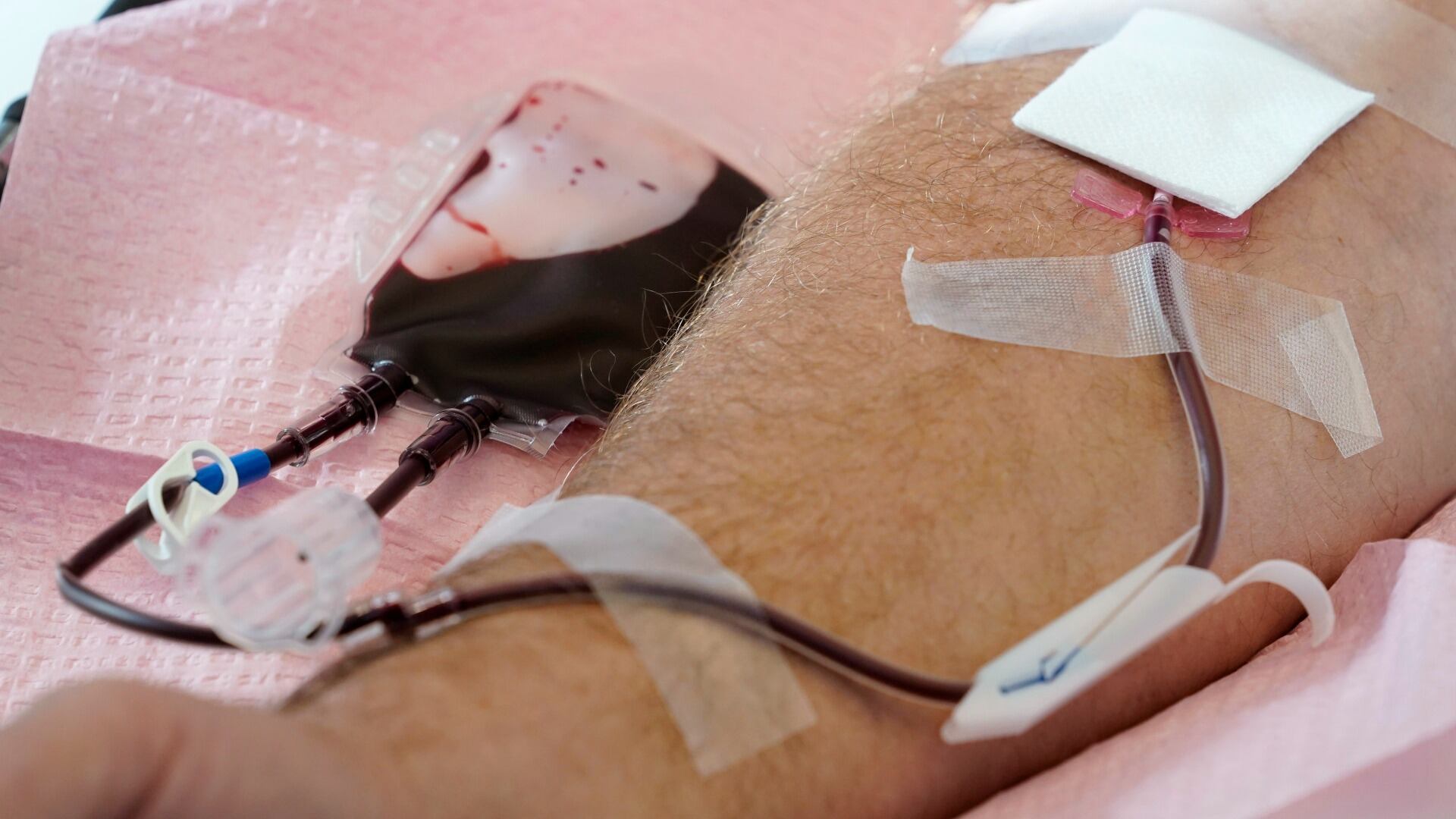
Tubes direct blood from a donor into a bag in Davenport, Iowa, on Friday, Nov. 11, 2022. The U.S. is moving to ease restrictions on blood donations from gay and bisexual men and other groups that traditionally face higher risks of HIV. The Food and Drug Administration on Friday, Jan. 27, 2023, announced draft guidelines that would do away with the current three-month abstinence requirement for donations from men who have sex with men. (AP Photo/Charlie Neibergall, File)
By Matthew Perrone
Gay and bisexual men in monogamous relationships can donate blood in the U.S. without abstaining from sex, under a federal policy finalized Thursday by health regulators.
The Food and Drug Administration guidelines ease decades-old restrictions designed to protect the blood supply from HIV. The agency announced plans for the change in January and said this week the new approach can now be implemented by blood banks.
The updated guidelines do away with a requirement that men who have sex with men abstain from sex for three months prior to giving blood.
Instead, all potential donors — regardless of sexual orientation, sex or gender — will be screened with a new questionnaire that evaluates their individual risks for HIV based on sexual behavior, recent partners and other factors. Potential donors who report having anal sex with new partners in the last three months will be barred from giving until a later date.
The FDA said the new policy reflects the latest scientific evidence and is in line with rules in the U.K. and Canada.
It’s the latest move by the FDA to broaden donor eligibility, with the potential to boost donations.
“The implementation of these recommendations will represent a significant milestone for the agency and the LGBTQI+ community,” Dr. Peter Marks, director of the FDA's center for biological therapies, said in a statement.
Gay rights groups have long opposed blanket restrictions on who can give blood, saying they discriminate. Medical societies including the American Medical Association have also said such exclusions are unnecessary given advances in blood testing.
Anyone who has ever tested positive for HIV will continue to be ineligible to donate blood. Those taking pills to prevent HIV through sexual contact will also still be barred, until three months after their last dose. The FDA noted that the medications, known as PrEP, can delay the detection of the virus in screening tests.
The FDA sets requirements and procedures for U.S. blood banks. All potential donors answer questions about their sexual history, injectable drug use and any recent tattoos or piercings, among other factors that can contribute to the spread of blood-borne infections. Donated blood is then tested for HIV, hepatitis C, syphilis and other infectious diseases.
In 2015, the FDA dropped the lifetime ban on donations from men who have sex with men and replaced it with a one-year abstinence requirement. Then in 2020, the agency shortened the abstinence period to three months, after donations plummeted during the COVID-19 pandemic.
Regulators said there has been no negative impact on the blood supply as a result of those changes.
___
The Associated Press Health and Science Department receives support from the Howard Hughes Medical Institute’s Science and Educational Media Group. The AP is solely responsible for all content.
William Li and Danielle Chang, co-founders of The Hao Life, join Cheddar Innovates to discuss how they're shaking up the $71 billion supplement industry by putting a modern spin on traditional natural Chinese remedies.
The Coca-Cola Company is teaming up with science education personality Bill Nye as part of its World Without Waste Initiative to describe the bottle-to-bottle plastic recycling process through a vividly animated, stop-motion short film. Christine Yeager, director of sustainability at The Coca-Cola Company, North America, joined Cheddar News to talk about their initiative and the partnership. "We really wanted to partner with someone who can help us make recycling relatable, but also has a very um respected voice in the climate change space," she said.
Catching you up on what you need to know on Apr 14, 2022, with the U.S. sending $800M to Ukraine, updates on the subway shooting in Brooklyn, Gov. Abbott putting a pause on his southern border truck inspections, migrants being bused from Texas to Washington, DC, the travel mask mandate extending until May 3, and more.
Energy costs continue to rise, our electrical grid is outdated, and the focus on renewable energy is more important than ever. One company says it has an answer: pods that store solar energy for long-term, 24-hour usage that can also function as mini power grids and charge electric vehicles. Azelio's TES.PODs store solar energy during the day, and hold it for use around the clock, providing a solution for charging electric vehicles, powering rural areas, and much more. Jonas Wallmander, CEO of Azelio, joins Closing Bell to discuss the company's solar energy storage technology, how it can be used to power communities and build out electric vehicle charging infrastructure, and more.
Catching you up with what you need to know on Apr 12, 2022, with Russia concentrating forces in eastern Ukraine, rising inflation, severe weather from Minnesota to the Gulf Coast, Philadelphia brings back its indoor mask mandate, PG&E pays $55 million for wildfire settlement, and more
Catching you up on what you need to know on April 11, 2022, with updates on the Russia-Ukraine War, France’s presidential election, the record deforestation of the Amazon Rainforest, retail giant Amazon's objection to the Staten Island union vote, the worsening baby formula shortage, a lawsuit against Rutgers Law School, and a stomach illness possibly linked to Lucky Charms cereal.
SpaceX launched its first all commercial-crew mission to the International Space Station on Friday. Cheddar News speaks with Jim Cantrell, CEO and President of Phantom Space Corporation why this launch is a big leap for space tourism.
Nautilus Labs closed $34 million in funding from investors including the Microsoft Climate Innovation Fund. The company plans to use its funding to improve shipping industry efficiency with its software. Nautilus CEO Matt Heider joined Cheddar News to talk about how it tackles the carbon emissions in the global supply chain. "We've seen on 10-day voyages saving $60,000 worth of fuel just by managing speed with greater confidence around the future. The environmental impact of that is also huge," he said. "Saving that amount of fuel is a kind of taking over 1000 cars off the road this year."