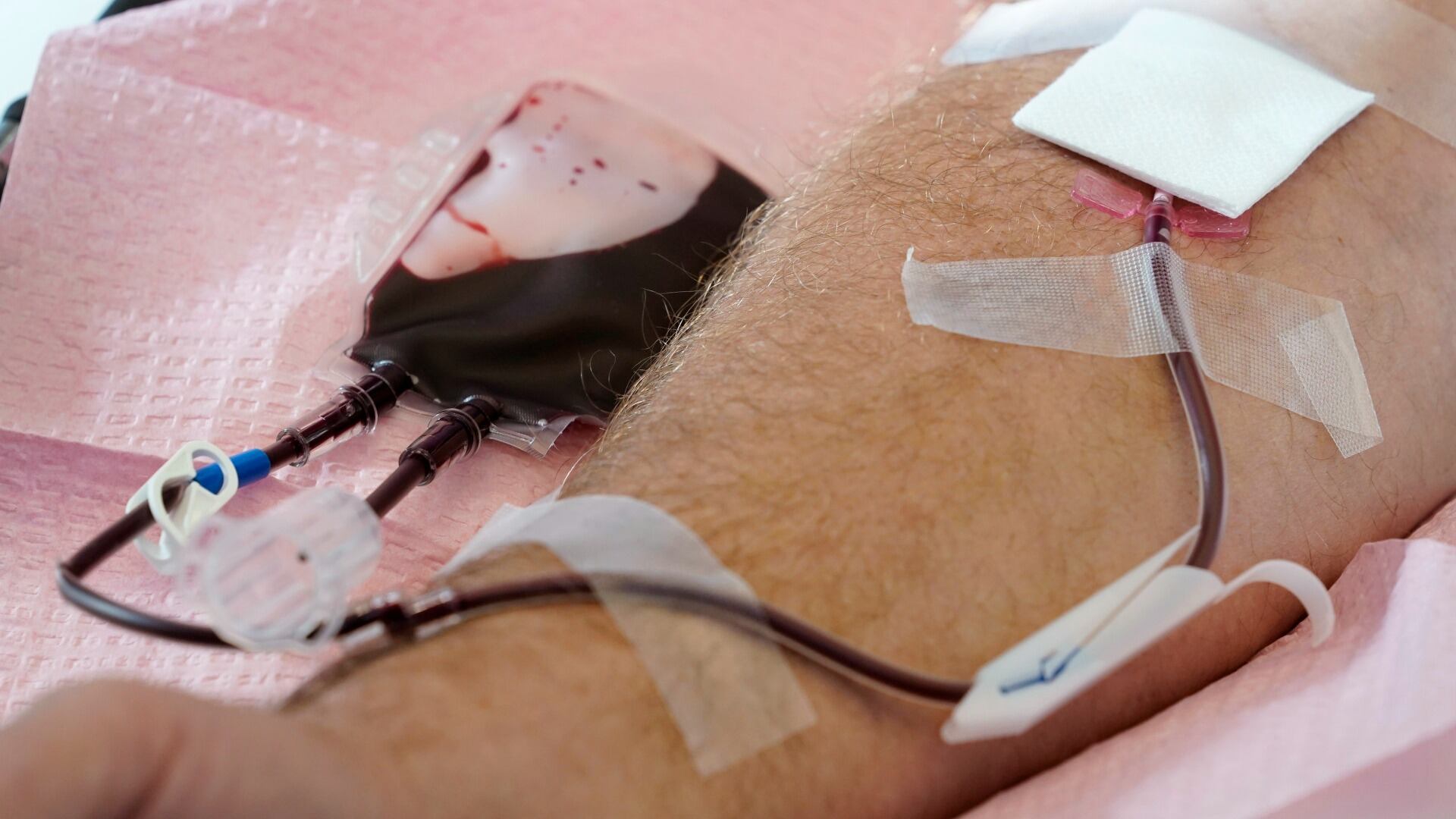
Tubes direct blood from a donor into a bag in Davenport, Iowa, on Friday, Nov. 11, 2022. The U.S. is moving to ease restrictions on blood donations from gay and bisexual men and other groups that traditionally face higher risks of HIV. The Food and Drug Administration on Friday, Jan. 27, 2023, announced draft guidelines that would do away with the current three-month abstinence requirement for donations from men who have sex with men. (AP Photo/Charlie Neibergall, File)
By Matthew Perrone
Gay and bisexual men in monogamous relationships can donate blood in the U.S. without abstaining from sex, under a federal policy finalized Thursday by health regulators.
The Food and Drug Administration guidelines ease decades-old restrictions designed to protect the blood supply from HIV. The agency announced plans for the change in January and said this week the new approach can now be implemented by blood banks.
The updated guidelines do away with a requirement that men who have sex with men abstain from sex for three months prior to giving blood.
Instead, all potential donors — regardless of sexual orientation, sex or gender — will be screened with a new questionnaire that evaluates their individual risks for HIV based on sexual behavior, recent partners and other factors. Potential donors who report having anal sex with new partners in the last three months will be barred from giving until a later date.
The FDA said the new policy reflects the latest scientific evidence and is in line with rules in the U.K. and Canada.
It’s the latest move by the FDA to broaden donor eligibility, with the potential to boost donations.
“The implementation of these recommendations will represent a significant milestone for the agency and the LGBTQI+ community,” Dr. Peter Marks, director of the FDA's center for biological therapies, said in a statement.
Gay rights groups have long opposed blanket restrictions on who can give blood, saying they discriminate. Medical societies including the American Medical Association have also said such exclusions are unnecessary given advances in blood testing.
Anyone who has ever tested positive for HIV will continue to be ineligible to donate blood. Those taking pills to prevent HIV through sexual contact will also still be barred, until three months after their last dose. The FDA noted that the medications, known as PrEP, can delay the detection of the virus in screening tests.
The FDA sets requirements and procedures for U.S. blood banks. All potential donors answer questions about their sexual history, injectable drug use and any recent tattoos or piercings, among other factors that can contribute to the spread of blood-borne infections. Donated blood is then tested for HIV, hepatitis C, syphilis and other infectious diseases.
In 2015, the FDA dropped the lifetime ban on donations from men who have sex with men and replaced it with a one-year abstinence requirement. Then in 2020, the agency shortened the abstinence period to three months, after donations plummeted during the COVID-19 pandemic.
Regulators said there has been no negative impact on the blood supply as a result of those changes.
___
The Associated Press Health and Science Department receives support from the Howard Hughes Medical Institute’s Science and Educational Media Group. The AP is solely responsible for all content.
A new report from Dr. Michael Worobey alleges that it is likely that COVID-19 originated from a raccoon dog at the Wuhan live animal market in China. While his report does not rule out the coronavirus could have escaped from a lab, Worobey's evidence points to a natural origin.
Jill and Carlo are back to cover the latest in the Rittenhouse trial, new information on the origins of Covid, return-to-office and more.
JOIN US FOR THE YOUTUBE WATCH PARTY @ 9aET: http://www.youtube.com/cheddarnow
Over the weekend, Russia fired a missile at one of its own satellites, triggering an explosion that launched thousands of pieces of shrapnel through space and forced the astronauts aboard the International Space Station to shelter in place. Senior Writer from Space.com Chelsea 'Foxanne' Gohd, joined Cheddar to discuss more.
Gerald Comissiong, CEO of Todos Medical, joins None of the Above to discuss why we're seeing surges of COVID-19 cases in Europe, the potential for a winter surge of COVID-19, the benefits of high vaccination rates in a community, and the coming COVID treatment pills.
Cognitive healthcare platform BrainCheck recently raised $10 million in a Series B round. The platform offers neurologists a new way to detect and care for brain disorders like Alzeheimer's, and brain injuries like concussions. BrainCheck CEO Yael Katz joined Cheddar News' Closing Bell to discuss.
On this episode of Cheddar Innovates: Ice Barrel CEO breaks down the physical and mental health benefits to cold therapy training; Dishcraft CEO explains how its robotics is transforming the role of a dishwasher in restaurant kitchens; A look at Curiosity Stream's original series 'The Year That Rocked The World.'
Jill Wagner is joined by Baker to talk about kids and vaccines: we finally know how many young kids are getting vaccinated. Plus, Democrats are working on a Plan B for paid family leave. And the salad chain Sweetgreen goes public.
A breakthrough deal between the U.S. and China when it comes to climate has finally been reached. The two countries have pledged to work together to curb carbon emissions. Amy Harder, executive editor at Cipher, joined Cheddar News to discuss more.
Joey Roulette, space reporter for The New York Times, joined Cheddar to break down the intense backlash Russia is seeing after its missile test sent destroyed a non-functioning satellite and sent thousands of pieces of debris potentially at the ISS, endangering astronauts onboard. He said while the blast happened days ago, there is still some risk to the station as the space junk threat remains. So far, the U.S., NATO, and the European Union have condemned Russia for the test.
Jill is joined by “Friend of the Pod” Mosheh Oinounou to talk booster shots, and whether “fully vaccinated” will eventually mean three shots, not two. Plus, the latest on the Kyle Rittenhouse trial. And the research is in: we know now the perfect way to hug. Also, Jill and Mosheh debate whether Airpods are passé.