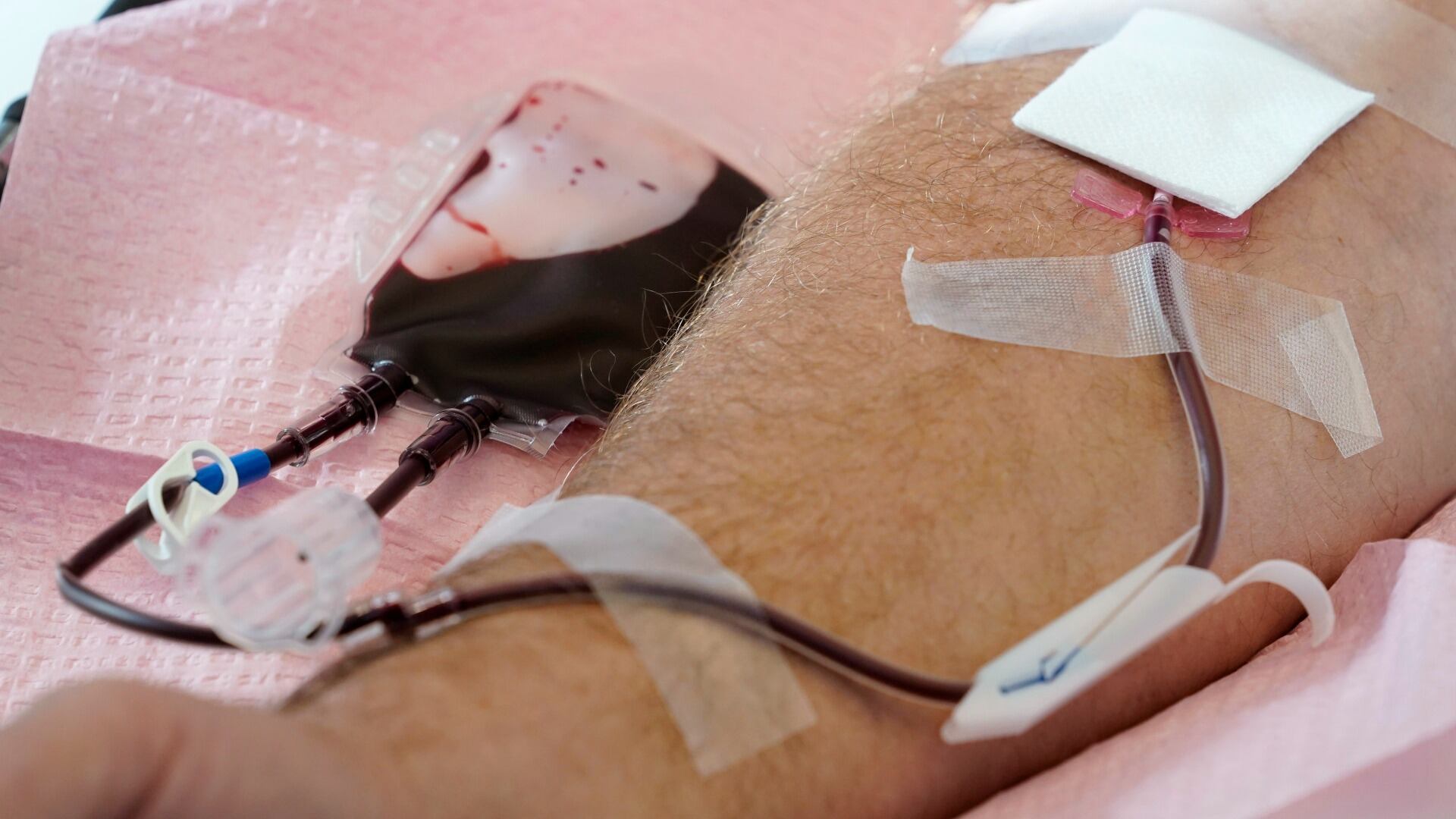
Tubes direct blood from a donor into a bag in Davenport, Iowa, on Friday, Nov. 11, 2022. The U.S. is moving to ease restrictions on blood donations from gay and bisexual men and other groups that traditionally face higher risks of HIV. The Food and Drug Administration on Friday, Jan. 27, 2023, announced draft guidelines that would do away with the current three-month abstinence requirement for donations from men who have sex with men. (AP Photo/Charlie Neibergall, File)
By Matthew Perrone
Gay and bisexual men in monogamous relationships can donate blood in the U.S. without abstaining from sex, under a federal policy finalized Thursday by health regulators.
The Food and Drug Administration guidelines ease decades-old restrictions designed to protect the blood supply from HIV. The agency announced plans for the change in January and said this week the new approach can now be implemented by blood banks.
The updated guidelines do away with a requirement that men who have sex with men abstain from sex for three months prior to giving blood.
Instead, all potential donors — regardless of sexual orientation, sex or gender — will be screened with a new questionnaire that evaluates their individual risks for HIV based on sexual behavior, recent partners and other factors. Potential donors who report having anal sex with new partners in the last three months will be barred from giving until a later date.
The FDA said the new policy reflects the latest scientific evidence and is in line with rules in the U.K. and Canada.
It’s the latest move by the FDA to broaden donor eligibility, with the potential to boost donations.
“The implementation of these recommendations will represent a significant milestone for the agency and the LGBTQI+ community,” Dr. Peter Marks, director of the FDA's center for biological therapies, said in a statement.
Gay rights groups have long opposed blanket restrictions on who can give blood, saying they discriminate. Medical societies including the American Medical Association have also said such exclusions are unnecessary given advances in blood testing.
Anyone who has ever tested positive for HIV will continue to be ineligible to donate blood. Those taking pills to prevent HIV through sexual contact will also still be barred, until three months after their last dose. The FDA noted that the medications, known as PrEP, can delay the detection of the virus in screening tests.
The FDA sets requirements and procedures for U.S. blood banks. All potential donors answer questions about their sexual history, injectable drug use and any recent tattoos or piercings, among other factors that can contribute to the spread of blood-borne infections. Donated blood is then tested for HIV, hepatitis C, syphilis and other infectious diseases.
In 2015, the FDA dropped the lifetime ban on donations from men who have sex with men and replaced it with a one-year abstinence requirement. Then in 2020, the agency shortened the abstinence period to three months, after donations plummeted during the COVID-19 pandemic.
Regulators said there has been no negative impact on the blood supply as a result of those changes.
___
The Associated Press Health and Science Department receives support from the Howard Hughes Medical Institute’s Science and Educational Media Group. The AP is solely responsible for all content.
With the emergence of the omicron variant, the U.S. is considering tightening international travel guidelines. The CDC said it might reduce the window for foreign travelers to submit a negative COVID-19 test from three days prior to one day before allowing entry.
Jill and Carlo cover the latest on Omicron, another school shooting in America and more. Plus, bidding farewell to 'transitory' inflation, and the controversy surrounding 'Lovely Bones' author Alice Sebold.
Sarav Arunachalam, air pollution scientist at the University of North Carolina at Chapel Hill, joins Cheddar Climate, where he discusses what he needs to happen when it comes to EV production on a global level to help reduce the effects of climate change.
The United Nations Secretary-General said this year that his agency's warning about climate change was a 'code red for humanity.' So how will political pledges to lower emissions, increase green energy, and ramp up electric vehicle infrastructure play out, and can we reverse some climate damage next year? Vijay Vaitheeswaran, Global energy & climate innovation editor for The Economist, and host of 'To a Lesser Degree,' The Economist’s podcast on climate change, joins Cheddar Climate to discuss what we can look ahead to in 2022, including global policy shifts and investments from the private and public sectors, holding global leaders accountable, and more.
In recent years, extreme weather events like flooding and wildfires have become more frequent, and more severe - and scientists say global warming is to blame. Climate crises could leave people in need of help, and that's where Global Rescue steps in. The crisis response firm employs former Navy Seals and Army Rangers to rescue travelers from climate-related emergencies. Global Rescue CEO Dan Richards joins Cheddar Climate to discuss.
Jennifer Lotito, president and COO at the non-profit (RED), joined Cheddar to discuss the CODE (RED) campaign as the organization looks to expand its mission to support both AIDS and COVID-19 relief. She explained that people can get involved in the campaign for Giving Tuesday and ahead of World AIDS Day by shopping (RED) branded products and even using credit card rewards points to add their own support. Lotito also pointed out that COVID-19 has also impacted HIV testing as people avoid clinics out of fear of the other pandemic.
NASA indefinitely delayed a spacewalk to repair an ISS antenna, citing concerns about space debris. It was unclear if the warning from the space agency to astronauts aboard the ISS was related to the recent destruction of a non-functioning Russian satellite.