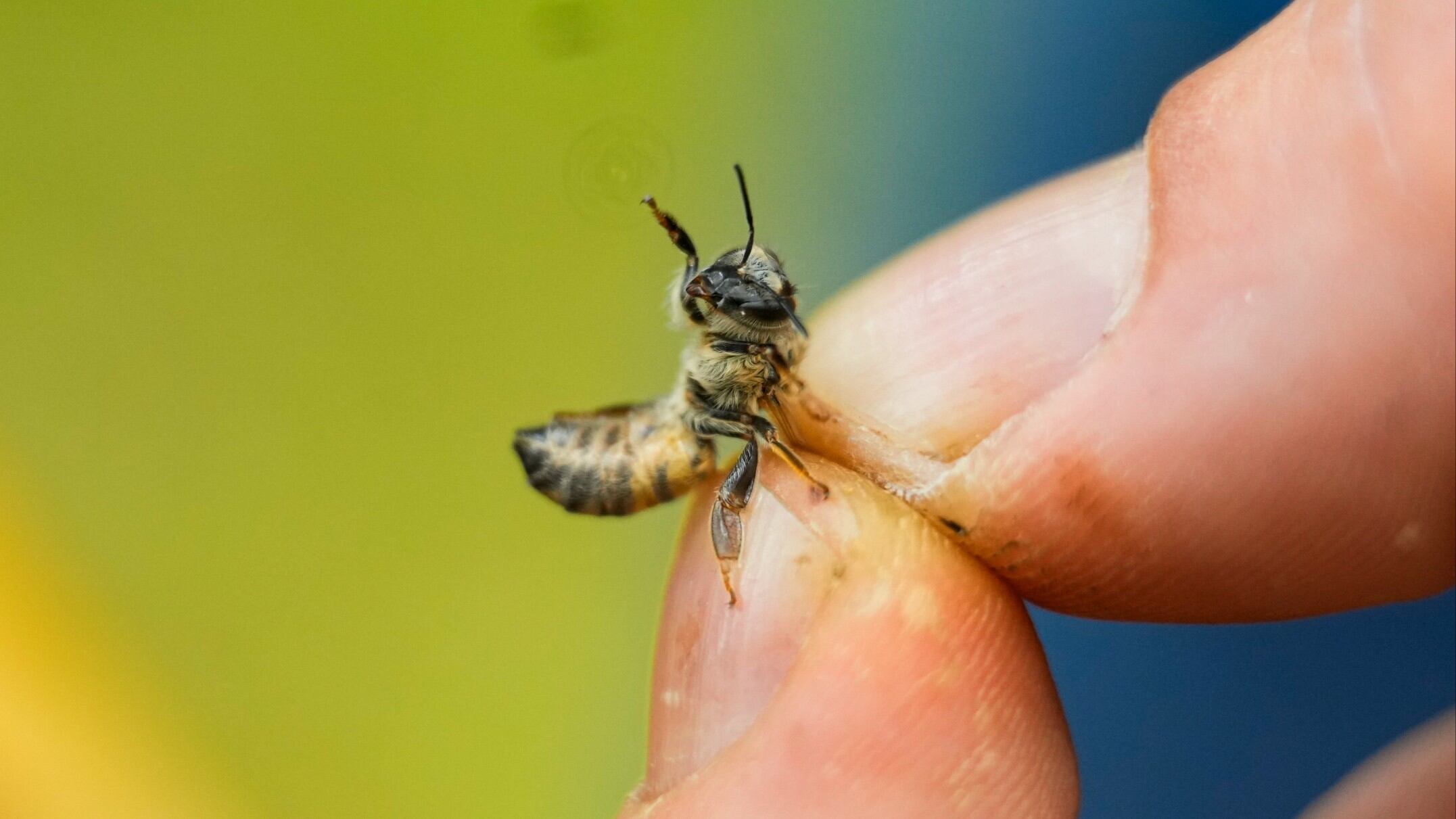
Zac Lamas, post doctoral fellow at ORISE, holds a bee as he inspects them for the parasitic mite Varroa at a hive in the backyard of University of Maryland bee researcher Nathalie Steinhauer on Wednesday, June 21, 2023, in College Park, Md. A new survey says America's honeybee hives just staggered through the second highest death rate on record. The mites are a factor why bee deaths are on the rise. (AP Photo/Julio Cortez)
By Seth Borenstein
America’s honeybee hives just staggered through the second highest death rate on record, with beekeepers losing nearly half of their managed colonies, an annual bee survey found.
But using costly and Herculean measures to create new colonies, beekeepers are somehow keeping afloat. Thursday’s University of Maryland and Auburn University survey found that even though 48% of colonies were lost in the year that ended April 1, the number of United States honeybee colonies "remained relatively stable.”
Honeybees are crucial to the food supply, pollinating more than 100 of the crops we eat, including nuts, vegetables, berries, citrus and melons. Scientists said a combination of parasites, pesticides, starvation and climate change keep causing large die-offs.
Last year’s 48% annual loss is up from the previous year’s loss of 39% and the 12-year average of 39.6%, but it’s not as high as 2020-2021’s 50.8% mortality rate, the survey found. Beekeepers told the surveying scientists that 21% loss over the winter is acceptable and more than three-fifths of beekeepers surveyed said their losses were higher than that.
“This is a very troubling loss number when we barely manage sufficient colonies to meet pollination demands in the U.S.,” said former government bee scientist Jeff Pettis, president of the global beekeeper association Apimondia that wasn’t part of the study. “It also highlights the hard work that beekeepers must do to rebuild their colony numbers each year."
The overall bee colony population is relatively steady because commercial beekeepers split and restock their hives, finding or buying new queens, or even starter packs for colonies, said University of Maryland bee researcher Nathalie Steinhauer, the survey’s lead author. It's an expensive and time consuming process.
The prognosis is not as bad as 15 years ago because beekeepers have learned how to rebound from big losses, she said.
“The situation is not really getting worse, but it’s also not really getting better,” Steinhauer said. “It is not a bee apocalypse.”
Despite big annual losses the situation is a far cry from 2007 when many bee experts expected an end to managed pollination said U.S. Department Agriculture research entomologist Jay Evans, who wasn’t part of the survey.
“There are threats certainly in the environment and honeybees have persisted,” Evans said. “I don’t think honeybees will go extinct but I think they will always have these sort of challenges.”
Some commercial beekeepers who have succeeded in the past lost as much as 80% of their colonies this past year, while other beekeepers did well, it varied so much, Evans said. Pettis, who has 150 colonies on Maryland’s Eastern shore, had less than 18% loss, saying he used organic acids for mite control.
The parasitic mite Varroa destructor that helps transmit viruses is the chief culprit, but bad weather and queen issues were also big problems in the past year, Steinhauer said. Pesticides also make things worse because it makes bees more vulnerable to diseases and less likely to seek food, she said.
“It really can be like death by a thousand cuts with the most obvious one being varroa,” Steinhauer said.
The mite varroa is a flat creature that crawls on the bee – it would be the equivalent of a frisbee or flat softball on human bodies – Evans said. The mite seems to make it easier for viruses to attack and kill bees, he and Steinhauer said.
It used to take large amounts of varroa, such as in 60% of a colony, to cause virus problems, but now even small infestations at 1% or 2% in a colony can cause massive problems, Steinhauer said.
“We are fighting this evolving enemy,” Steinhauer said.
Another problem is landscapes that have only one crop or homogenous landscapes which deprive bees of food, while pesticides and bouts of extreme weather also have caused problems.
For example in the Washington, D.C. area unusual 80-degree warmth in January brought some bees out of their normal winter routine and then when it turned cool again, they had problems, Evans said.
“The impact of climate change on bee colony survival is real and can go undetected,” Pettis said in an email.
The demand for pollination from commercial bee colonies is growing even as the beekeepers have to work harder to make up for losses, Steinhauer said. The U.S. Department of Agriculture says 35% of the human diet comes from insect-pollinated plants and the honeybee is responsible for 80% of that pollination.
“There is this whole side of our agricultural industry that relies on these colonies,” Steinhauer said. “And the fact that every year the commercial beekeepers have to invest so much more effort to keep those numbers up because they have to fulfill those pollination contracts puts a lot of stress on those beekeepers and the bees.” ___
After the latest school shooting in Uvalde, Texas, it wouldn't be a surprise if the traumatic event takes a toll on your mental health — or that of your children. Amy Morin, the editor-in-chief of Verywell Mind and licensed psychotherapist, joined Cheddar News to share coping skills and offer advice about how to talk to your children about these increasingly common tragic events. “I think its important for parents to know what the school’s plan is, what the teacher's plan is, and then we can have our own plans with kids too," she noted. "It's so important for us to talk to kids about how they're feeling — guaranteed they've heard something about it, so ask them what they know already, use age-appropriate language, and rather than just dismissing their fears by saying don't worry about it or I'm sure you'll be safe, talk to them about their feelings."
An recently conducted AP-NORC poll found that majorities of the Black and Hispanic populations in the U.S. still find themselves either somewhat worried or extremely worried over the pandemic, while more than half of white Americans responded with either being not too worried or not worried at all. Dr. Chris Pernell, the chief strategic integration and health equity officer at University Hospital, joined Cheddar News to talk about how perceptions of COVID-19 differ between groups of Americans. "We’re still seeing people get infected, and because of the toll of the disproportionate impact, we have concerns among the Black and brown community about whether or not they have an increased risk of exposure because of where they work, because of the use of public transportation, because they live in homes that they may not be able to safely quarantine and or isolate in, and because they have at baseline chronic health conditions that may make coronavirus more severe in those persons," she said.
Judith Enck, a former regional administrator for the EPA and the president of Beyond Plastics, joined Cheddar News to talk about the role of plastics in the climate crisis and California's investigation of ExxonMobil and other oil companies for misleading the public on the ability to recycle plastics. "The reason why petrochemical companies like Exxon have gotten away with selling more and more plastic is that they've lied to the public and told us don't worry about all those negative upstream impacts and downstream impacts of plastics. Just be sure to recycle it. Well, guess what? Plastics largely are not recycled," Enck said.
Catching you up on what you need to know on April 29, 2022, with President Biden asking Congress for a $33 billion aid package for Ukraine, a shrinking GDP potentially leading to a recession, Beijing banning weddings and funerals while closings schools amid COVID, and more.
Virtual care and digital medicine provider Biofourmis recently raised $300 million in a Series D round led by General Atlantic and with participation from CVS Health. Biofourmis offers at-home care and digital therapies backed by artificial intelligence, which can remotely monitor patients while they are at home. The company says it hopes its technology can improve patient outcomes while reducing the cost and burden of care. Kuldeep Signh Rajput, Founder and CEO of Biofourmis, joins Cheddar News' Closing Bell to discuss.
Moderna is asking the FDA to consider emergency use authorization for its COVID vaccine to be used with children under 6 years old. Dr. Christina Johns, a senior medical advisor at PM Pediatrics, joined Cheddar News to talk about the pharmaceutical company's research into the safety and efficacy of the vaccine for the very youngest of children. "This is very exciting news because children met that goal in their neutralizing antibody response in this age group — means that we really can extrapolate a lot from what we know about data in adults," she said. "I will say that there's a caveat that we have not seen yet the full dataset released, so I'm waiting for that and my fingers are crossed for next week."
Mental health platform Real recently raised $37 million in a Series B round led by Owl Ventures. Through its mobile app, Real says it provides mental health care at a lower cost than traditional therapy and aims to make mental wellness a part of everyone's daily routine. The company also announced that U.S. soccer star Megan Rapinoe will serve as an adviser to the company. Ariela Safira, Founder & CEO of Real, joins Cheddar News' Closing Bell to discuss.
Catching you up on what you need to know on April 28, 2022, with Elon Musk mocking Twitter's top legal exec Vijaya Gadde on the platform itself, a probe in George Floyd's death finding discrimination within the Minneapolis police force, the latest California drought leading to new water restrictions, and more.