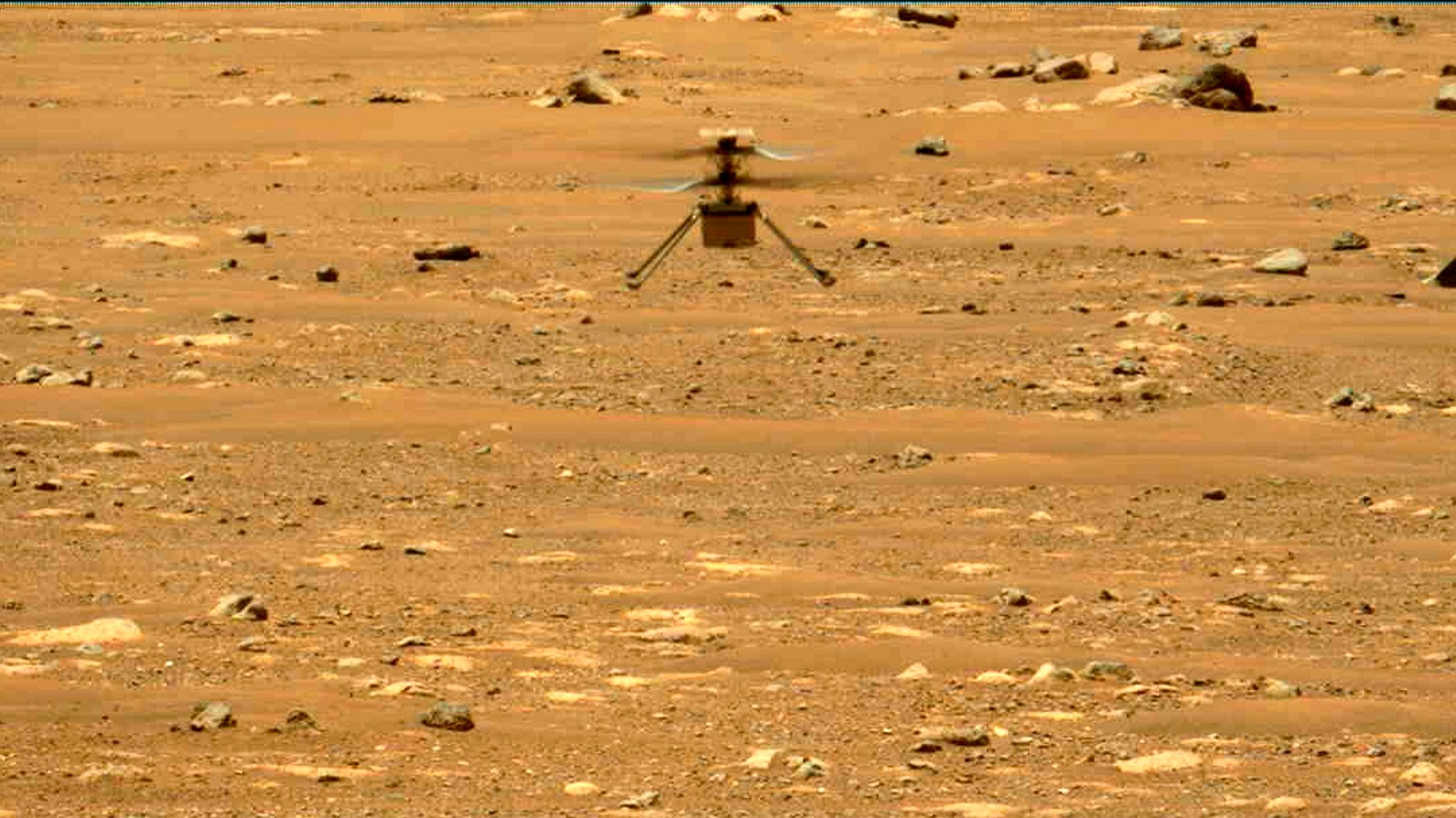
In this image made available by NASA, the Mars Ingenuity helicopter hovers above the surface of the planet during its second flight on Thursday, April 22, 2021. (NASA/JPL-Caltech/ASU/MSSS via AP)
By Marcia Dunn
NASA’s little Mars helicopter aced its second test flight Thursday, soaring even higher and longer than before.
The 4-pound (1.8-kilogram) chopper, named Ingenuity, hovered longer and also flew side to side this time, according to NASA's Jet Propulsion Laboratory in California. It achieved the intended altitude of 16 feet (5 meters) and even accelerated sideways 7 feet (2 meters).
This hop lasted 52 seconds, 13 seconds longer than the first one.
“Go big or go home!” JPL tweeted in announcing the Earth Day news.
The success came just three days after Ingenuity made the first powered flight by an aircraft on another planet. The helicopter carried a bit of wing fabric from the Wright Flyer that made similar history at Kitty Hawk, North Carolina, in 1903.
Flight controllers had to wait four hours before learning Thursday's outcome. Like it did during Monday's 10-foot-high (3-meter-high) hop, the helicopter sent back a black and white photo showing its shadow against the dusty, rock-strewn surface now known as Wright Brothers Field.
“It sounds simple, but there are many unknowns regarding how to fly a helicopter on Mars," Ingenuity’s chief pilot, Havard Grip, said from JPL in a statement. “That’s why we’re here — to make these unknowns known.”
One of the challenges is the planet’s extremely thin atmosphere — 1% that of Earth's.
NASA plans up to three more test flights in the next 1 1/2 weeks, venturing higher each time with more complicated acrobatics. Ingenuity hitched a ride to Mars on the rover Perseverance, which photographed the proceedings from more than 200 feet (64 meters) away. The rover team allotted one month for the $85 million tech demo; The clock started ticking when Ingenuity was released from Perseverance's belly on April 3.
“We have two flights of Mars under our belts, which means that there is still a lot to learn during this month of Ingenuity," chief engineer Bob Balaram said in a statement.
Perseverance and Ingenuity arrived at Mars in mid-February, landing in an ancient river delta following a 6 1/2-month flight.
Once Ingenuity's flights are complete, Perseverance will set off on its journey to find any signs of past microscopic life. A robotic geologist, the rover will collect core samples of the most enticing rocks and set them aside for pickup by a future spacecraft a decade from now.
In another first, an experiment on the rover successfully converted Mars’ carbon-dioxide-rich atmosphere into pure oxygen this week. Five grams of oxygen was produced, according to NASA, the equivalent of 10 minutes of breathing for an astronaut. Large-scale production at Mars could yield oxygen not only for air, but also rocket fuel. More tests are planned over the next two years.
___
The Associated Press Health and Science Department receives support from the Howard Hughes Medical Institute’s Department of Science Education. The AP is solely responsible for all content.
Jill and Carlo discuss the pending approval for Pfizer's vaccine for kids, the state of anti-Semitism three years after Tree of Life, potential criminal charges in the 'Rust' prop gun shooting and more.
Amalgamated Bank is the first U.S. bank to publish science-based targets to reach net-zero greenhouse gas emissions by 2045. The bank says it will reach this goal through how it engages with customers and how it finances projects. Amalgamated Bank Chief Sustainability Officer Ivan Frishberg joined Cheddar Climate to provide more details about the bank's ambitious climate goals.
COP26 been dealt a blow as Chinese President Xi Jinping and Russian President Vladimir Putin, whose countries are responsible for a third of the world's annual greenhouse gas emissions, will not be in attendance. Bertrand Piccard, Chairman and Founder of the Solar Impulse Foundation, joins Cheddar Climate, where he discusses what he expects to see when the summit commences in Glasgow.
John Nosta, WHO Technology Expert, joins Cheddar News to discuss evolving technology in the healthcare industry and the role 5G is playing in advancing healthcare delivery.
According to the latest report from the UN, several countries around the world are "nowhere near" towards their goal of limiting gas emissions. This report comes ahead of the COP26 which is slated to take place in the month of November in Scotland. Senior Advisor at CDP Paula Diperna, joined Cheddar to discuss what the report highlights and what this tells us about the future plans of the Paris Climate Agreement.
Powerful weather systems over California have caused record amounts of rainfall in the state, including over wildfire-scorched lands since triggering massive landslides.
The FDA meets today on whether or not vaccines for children ages 5-11 can potentially become available to the public. Cheddar News was joined by Dr. Richard Besser, President and CEO of the Robert Wood Johnson Foundation and former Acting Director of the CDC to discuss what could come next for these vaccines.
Dan DePodwin, Director of Forecasting Operations at AccuWeather, joined Wake Up With Cheddar to talk about the extreme weather across the country, including damaging rains in the drought-stricken western U.S. and an incoming Nor'easter that's likely to cause flooding and power outages along the Atlantic coast.
Jill and Carlo cover the news out of Facebook's latest earnings, Tesla's monumental day, Dave Chappelle addresses controversy and the tragedy of the climate emergency.
The UN's World Meteorological Organization reported that carbon dioxide in the atmosphere hit record levels in 2020, despite coronavirus-related lockdowns. With the COP26 international meeting on climate change less than a week away, Risk and behavioral scientist Dr. Sweta Chakraborty joined Cheddar to break down the "code red for humanity" the report represents and what actual commitments must be made to prevent significant global temperature increases.