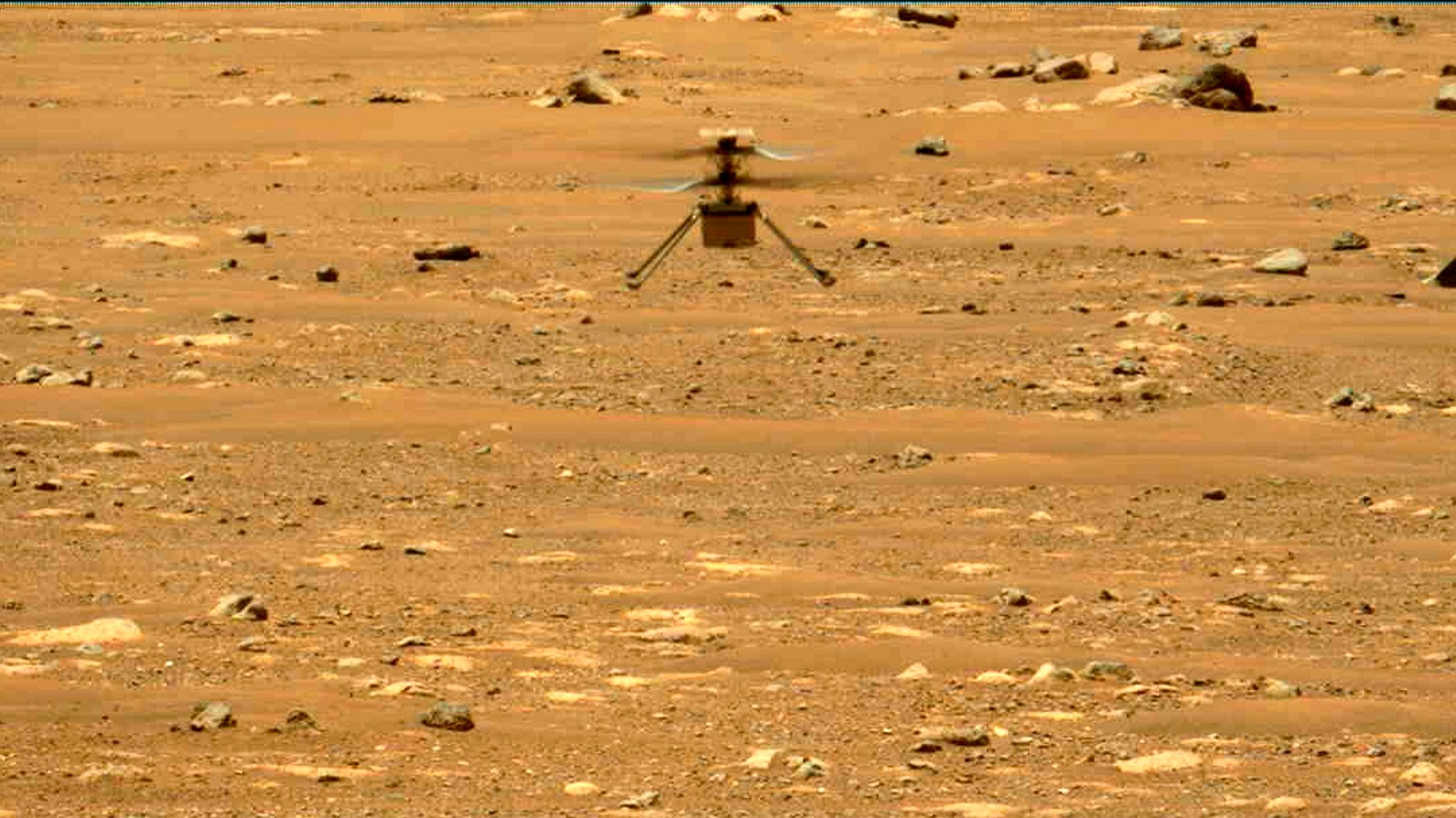
In this image made available by NASA, the Mars Ingenuity helicopter hovers above the surface of the planet during its second flight on Thursday, April 22, 2021. (NASA/JPL-Caltech/ASU/MSSS via AP)
By Marcia Dunn
NASA’s little Mars helicopter aced its second test flight Thursday, soaring even higher and longer than before.
The 4-pound (1.8-kilogram) chopper, named Ingenuity, hovered longer and also flew side to side this time, according to NASA's Jet Propulsion Laboratory in California. It achieved the intended altitude of 16 feet (5 meters) and even accelerated sideways 7 feet (2 meters).
This hop lasted 52 seconds, 13 seconds longer than the first one.
“Go big or go home!” JPL tweeted in announcing the Earth Day news.
The success came just three days after Ingenuity made the first powered flight by an aircraft on another planet. The helicopter carried a bit of wing fabric from the Wright Flyer that made similar history at Kitty Hawk, North Carolina, in 1903.
Flight controllers had to wait four hours before learning Thursday's outcome. Like it did during Monday's 10-foot-high (3-meter-high) hop, the helicopter sent back a black and white photo showing its shadow against the dusty, rock-strewn surface now known as Wright Brothers Field.
“It sounds simple, but there are many unknowns regarding how to fly a helicopter on Mars," Ingenuity’s chief pilot, Havard Grip, said from JPL in a statement. “That’s why we’re here — to make these unknowns known.”
One of the challenges is the planet’s extremely thin atmosphere — 1% that of Earth's.
NASA plans up to three more test flights in the next 1 1/2 weeks, venturing higher each time with more complicated acrobatics. Ingenuity hitched a ride to Mars on the rover Perseverance, which photographed the proceedings from more than 200 feet (64 meters) away. The rover team allotted one month for the $85 million tech demo; The clock started ticking when Ingenuity was released from Perseverance's belly on April 3.
“We have two flights of Mars under our belts, which means that there is still a lot to learn during this month of Ingenuity," chief engineer Bob Balaram said in a statement.
Perseverance and Ingenuity arrived at Mars in mid-February, landing in an ancient river delta following a 6 1/2-month flight.
Once Ingenuity's flights are complete, Perseverance will set off on its journey to find any signs of past microscopic life. A robotic geologist, the rover will collect core samples of the most enticing rocks and set them aside for pickup by a future spacecraft a decade from now.
In another first, an experiment on the rover successfully converted Mars’ carbon-dioxide-rich atmosphere into pure oxygen this week. Five grams of oxygen was produced, according to NASA, the equivalent of 10 minutes of breathing for an astronaut. Large-scale production at Mars could yield oxygen not only for air, but also rocket fuel. More tests are planned over the next two years.
___
The Associated Press Health and Science Department receives support from the Howard Hughes Medical Institute’s Department of Science Education. The AP is solely responsible for all content.
A new report from Dr. Michael Worobey alleges that it is likely that COVID-19 originated from a raccoon dog at the Wuhan live animal market in China. While his report does not rule out the coronavirus could have escaped from a lab, Worobey's evidence points to a natural origin.
Jill and Carlo are back to cover the latest in the Rittenhouse trial, new information on the origins of Covid, return-to-office and more.
JOIN US FOR THE YOUTUBE WATCH PARTY @ 9aET: http://www.youtube.com/cheddarnow
Over the weekend, Russia fired a missile at one of its own satellites, triggering an explosion that launched thousands of pieces of shrapnel through space and forced the astronauts aboard the International Space Station to shelter in place. Senior Writer from Space.com Chelsea 'Foxanne' Gohd, joined Cheddar to discuss more.
Gerald Comissiong, CEO of Todos Medical, joins None of the Above to discuss why we're seeing surges of COVID-19 cases in Europe, the potential for a winter surge of COVID-19, the benefits of high vaccination rates in a community, and the coming COVID treatment pills.
Cognitive healthcare platform BrainCheck recently raised $10 million in a Series B round. The platform offers neurologists a new way to detect and care for brain disorders like Alzeheimer's, and brain injuries like concussions. BrainCheck CEO Yael Katz joined Cheddar News' Closing Bell to discuss.
On this episode of Cheddar Innovates: Ice Barrel CEO breaks down the physical and mental health benefits to cold therapy training; Dishcraft CEO explains how its robotics is transforming the role of a dishwasher in restaurant kitchens; A look at Curiosity Stream's original series 'The Year That Rocked The World.'
Jill Wagner is joined by Baker to talk about kids and vaccines: we finally know how many young kids are getting vaccinated. Plus, Democrats are working on a Plan B for paid family leave. And the salad chain Sweetgreen goes public.
A breakthrough deal between the U.S. and China when it comes to climate has finally been reached. The two countries have pledged to work together to curb carbon emissions. Amy Harder, executive editor at Cipher, joined Cheddar News to discuss more.
Joey Roulette, space reporter for The New York Times, joined Cheddar to break down the intense backlash Russia is seeing after its missile test sent destroyed a non-functioning satellite and sent thousands of pieces of debris potentially at the ISS, endangering astronauts onboard. He said while the blast happened days ago, there is still some risk to the station as the space junk threat remains. So far, the U.S., NATO, and the European Union have condemned Russia for the test.
Jill is joined by “Friend of the Pod” Mosheh Oinounou to talk booster shots, and whether “fully vaccinated” will eventually mean three shots, not two. Plus, the latest on the Kyle Rittenhouse trial. And the research is in: we know now the perfect way to hug. Also, Jill and Mosheh debate whether Airpods are passé.