By Michael Casey and Kathy McCormack
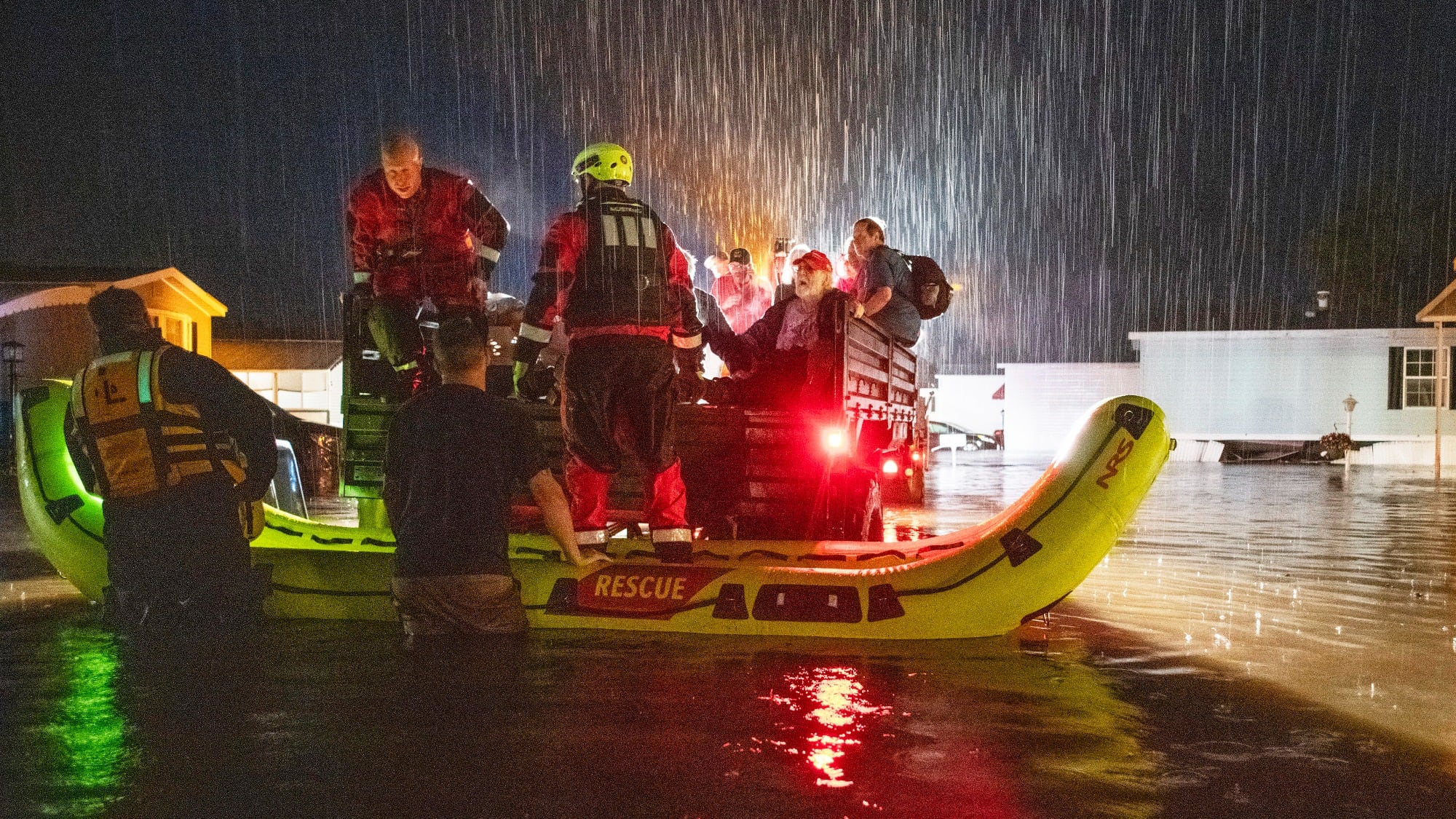
Heavy rainfall flooded parts of Massachusetts and Rhode Island, with two communities declaring a state of emergency as water poured into homes, creating moats around their foundations and leading to boat rescues of residents. Concern about a dam listed in poor condition led to more evacuations.
Weather officials described the rainfall as a “200-year event."
More storms were in the forecast for Wednesday, and although it was still early, winds and flooding from Hurricane Lee were expected to affect Rhode Island, eastern Massachusetts, southeastern New Hampshire and central and coastal Maine during the weekend, forecasters said.
Up to 300 people were evacuated by Tuesday morning in Leominster, about 40 miles (64 kilometers) northwest of Boston, Mayor Dean Mazzarella said. That included residents of a high-rise apartment building and a nursing home. All schools were closed and two shelters were opened.
Mazzarella said the city has not seen such widespread damage since a hurricane in 1936. He said most buildings downtown flooded and some collapsed. Rail service into Boston also was disrupted.
“The storm stopped over us last night. It didn't move for close to five hours. It had dumped 11 inches (28 centimeters) of rain,” Mazzarella said at a news conference Tuesday morning.
Mazzarella said Leominster has 12 hills, “and obviously, from those hills comes the water.”
On Monday night, in a recording posted online, Mazzarella had urged people to “Find a high spot somewhere. Find a high spot and stay there until this is over." He said if there were any injuries they were minor.
Matthew Belk, a meteorologist with the National Weather Service in Boston said a trained spotter near Leominster recorded 9.5 inches (24 centimeters) of rain, describing it as a “200-year event” meaning the chances of it happening in any given year is one in 200. The record for rainfall in a single day in Massachusetts was set Aug. 18, 1955, when Tropical Storm Diane dropped just over 18 inches (45 centimeters) in Westfield, according to Belk.
Massachusetts Gov. Maura Healey said her heart goes out to those in the path of the rain as she toured storm damage in North Attleboro, about 55 miles (88.5 kilometers) south of Leominster.
“It was really scary, the amount of water that fell in just a short amount of time and the incredible devastation that it caused,” Healey said, adding that her administration “will do everything we can to support them and their families.”
Steve Forcier, 62, said he was half asleep watching television in his mobile home when firefighters knocked on his door late Monday night.
“It was a little intimidating, a little frightening,” he said Tuesday morning outside the school where he and others spent the night. “When I looked out there, I said, ‘Holy crap!’”
The water outside was about waist-high, Forcier said, but he had minimal damage to his home when he evacuated. Firefighters used inflatable rafts to bring residents of the mobile home park to trucks and buses.
“It’s been a very emotional roller coaster for many,” Leominster Schools Superintendent Paula Deacon said outside the shelter, where at least 80 people had stayed overnight. "They don’t know what happened to their homes, many of them left with nothing, so they’re anxious to get back to see the conditions of where they live, talk to people they care about,” she said.
Deacon said she’s never experienced that type of emergency response and came away impressed.
“There were so many people here with open arms to help navigate. We just all jumped in and started taking care of one another, and that’s a tribute to this community.”
Early Tuesday, the city said people living in areas near a brook and the North Nashua River in Leominster should “immediately evacuate” as a precaution, “due to a potential issue at the Barrett Park Pond Dam.”
“This particular dam is one that we're actually about to replace, and it is very sensitive. It is water-saturated and we worry about that downstream," Mazzarella said at the news conference.
The dam is a 15-foot-tall (4.5-meter-tall) earthen structure listed in poor condition and posing a significant hazard, meaning its failure could result in economic damages, but would not be expected to cause loss of life, according to the U.S. Army Corps of Engineers’ National Inventory of Dams. The database shows it was last inspected in November 2017, though it’s supposed to be inspected every five years.
In 2021, the city was awarded a $163,500 grant from the state Executive Office of Energy and Environmental Affairs for engineering and permitting costs associated with repairs and improvements to the dam. That was part of more than $17.3 million in grants awarded at the time to address failing dams, coastal infrastructure, and levees across the state.
Mazzarella said Tuesday there were at least several homes in Leominster where “the water washed out around them" and the foundations could be seen about 8 feet (2.4 meters) below, as well as pipelines under the street.
According to a city planning document, low-lying areas of Leominster are particularly subject to periodic flooding. The North Nashua River experienced three notable high flows in March 1936, September 1938, and August 1955.
“During these floods, streets were inundated, dams were overtopped and bridges collapsed," the plan said.
Other communities also experienced flooding Monday night. In North Attleborough, the town said in a statement that crews worked to clear water from roads Monday night and about 200 homes had flood damage. Some roads in Rhode Island and in Nashua, New Hampshire, also were flooded.
Leominster and North Attleborough both declared states of emergency.
Little rain was expected Tuesday, but storms are expected to hit the area Wednesday afternoon and evening, and some could produce heavy rain, the National Weather Service said.
New England has experienced its share of flooding this summer, including a storm that dumped up to two months of rain in two days in Vermont in July, resulting in two deaths.
Atmospheric scientists say floods occurring in different parts of the world are fueled by climate change, with storms forming in a warmer atmosphere, making extreme rainfall more frequent. The additional warming scientists predict is coming will only make it worse.
McCormack reported from Concord, New Hampshire. Associated Press writers Holly Ramer in New Hampshire, Steve LeBlanc and Rodrique Ngowi in Massachusetts, David Sharp in Maine, Lisa Rathke in Vermont, and David Lieb in Missouri contributed to this report.