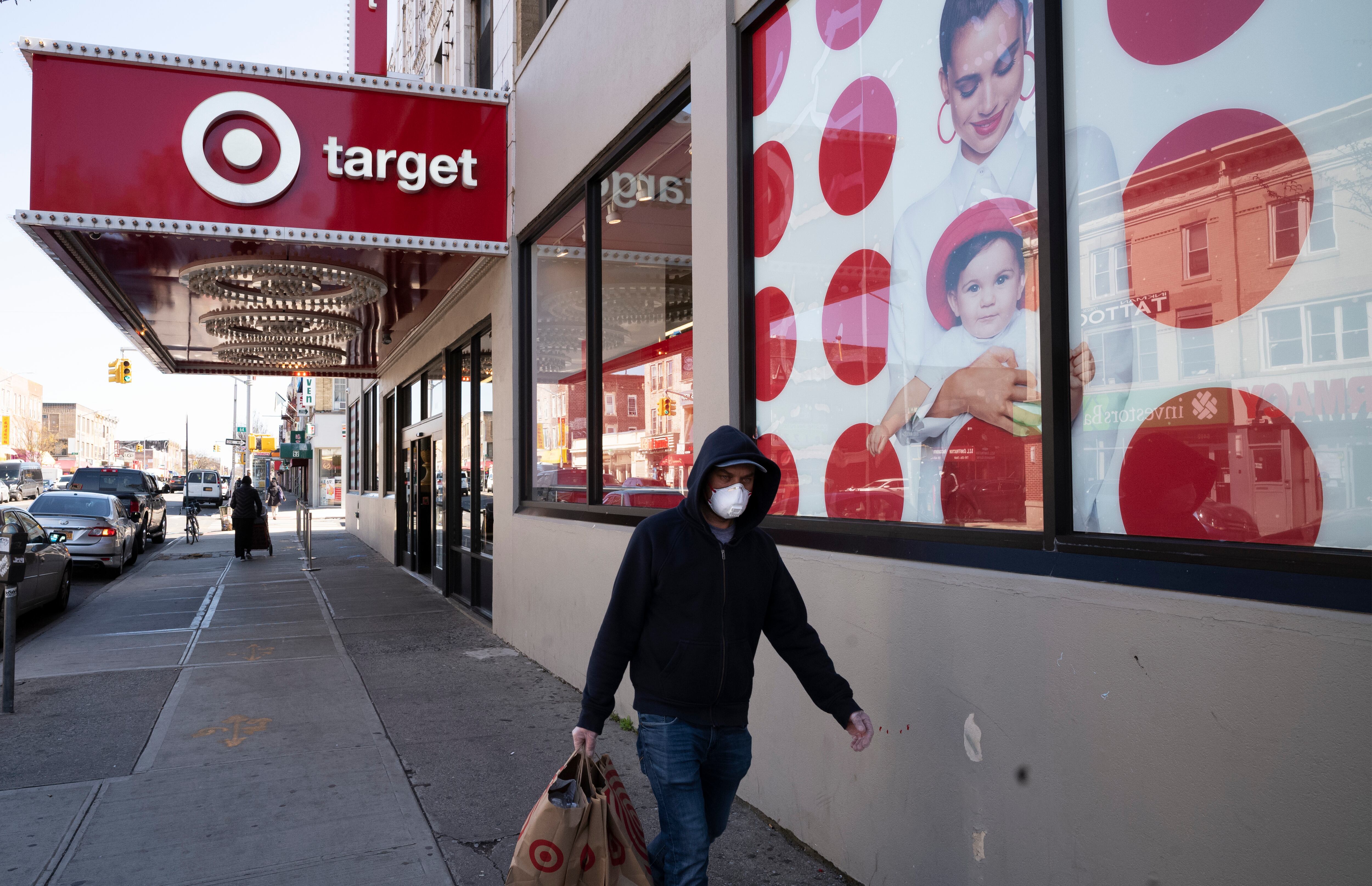
In this April 6, 2020 file photo, a customer wearing a mask carries his purchases as he leaves a Target store during the coronavirus pandemic in the Brooklyn borough of New York. Target has joined a growing list of major retailers that will require customers at all their stores to wear face coverings. The Minneapolis, Minnesota-based discounter said Thursday, July 16, that the policy will go into effect Aug. 1.(AP Photo/Mark Lennihan, File)
By Anne D'Innocenzio
Two major retailers on Thursday joined the growing list of national chains that will require customers to wear face masks regardless of where cities or states stand on the issue.
Target's mandatory face mask policy will go into effect Aug. 1, and all CVS stores will begin requiring them on Monday.
More than 80 percent of Target's 1,800 stores already require customers to wear masks due to local and state regulations. Target will hand out masks at entrances to those who need them.
The announcements come one day after the nation's largest retailer, Walmart, said that it would mandate face shields for all customers starting Monday.
Starbucks, Best Buy, Kohl's, and Kroger Co. have also announced mandatory masks nationwide.
Retailers have hesitated to make masks mandatory nationwide out of fear of angering some customers over what, even in a pandemic, has become a political issue.
They have been reluctant to put employees in the position of becoming enforcers. Confrontations with customers and store employees have played out in multiple incidents caught on video.
It was difficult to enforce such rules even in states that mandate face masks. However, the recent surge of new virus cases — particularly in Florida, California, Texas, and Arizona — has left them with no choice, retail experts say.
"To be clear, we're not asking our store employees to play the role of enforcer, " said Jon Roberts, the chief operating officer at CVS. "What we are asking is that customers help protect themselves and those around them by listening to the experts and heeding the call to wear a face covering."
Alexander Reed, CFA and CIO for Envisage Wealth, breaks down why he thinks rates could stay higher for longer and why real estate, utilities, and regional banks are sectors to avoid.
Big brands that have relied on TikTok videos to reach younger consumers do not appear to be panicking as they wait to see what happens. But they have started planning.
It's been 15 years since the last fatal crash of a U.S. airliner, but you wouldn't know that from a torrent of flight problems that made news in the last three months.
Abortion opponents want the high court to ratify a ruling from a conservative federal appeals court that would limit access to a medication called mifepristone, which was used in nearly two-thirds of abortions last year.
Annie Chechitelli, chief product officer at Turnitin, breaks down how students and teachers alike can learn from artificial intelligence – while still maintaining academic integrity.
Neiman Marcus Group CEO Geoffroy van Raemdonck talks luxury shopping and TikTok, why the company prefers to be private for now, and the benefits of flexible work arrangements.
Rebecca Walser, founder and CEO of Walser Wealth Management, discusses how geopolitical conditions, the bifurcated economy, and other volatility could weigh on markets.