By Jon Gambrell, Lujain Jo and Matthew Lee
Five Americans detained for years in Iran walked off a plane and into freedom Monday, most arm-in-arm, as part of a politically risky deal that saw President Joe Biden agree to the release of nearly $6 billion in frozen Iranian assets owed by a third country, South Korea.
The successful negotiations for the Americans' freedom brought Biden profuse thanks from their families but heat from Republican presidential rivals and other opponents for the monetary arrangement with one of America's top adversaries.
“Today, five innocent Americans who were imprisoned in Iran are finally coming home,” Biden said in a statement released as the plane carrying the group from Tehran landed in Doha, Qatar. A plane carrying the Americans home to the United States was due to land Monday night.
Iran’s hard-line President Ebrahim Raisi, on hand for the United Nations General Assembly in New York, suggested Monday's exchange could be “a step in the direction of a humanitarian action between us and America.”
“It can definitely help in building trust,” Raisi told journalists.
However, tensions are almost certain to remain high between the U.S. and Iran, which are locked in disputes over Tehran’s nuclear program and other matters. Iran says the program is peaceful, but it now enriches uranium closer than ever to weapons-grade levels.
The prisoner release unfolded amid a major American military buildup in the Persian Gulf, with the possibility of U.S. troops boarding and guarding commercial ships in the Strait of Hormuz, through which 20% of all oil shipments pass.
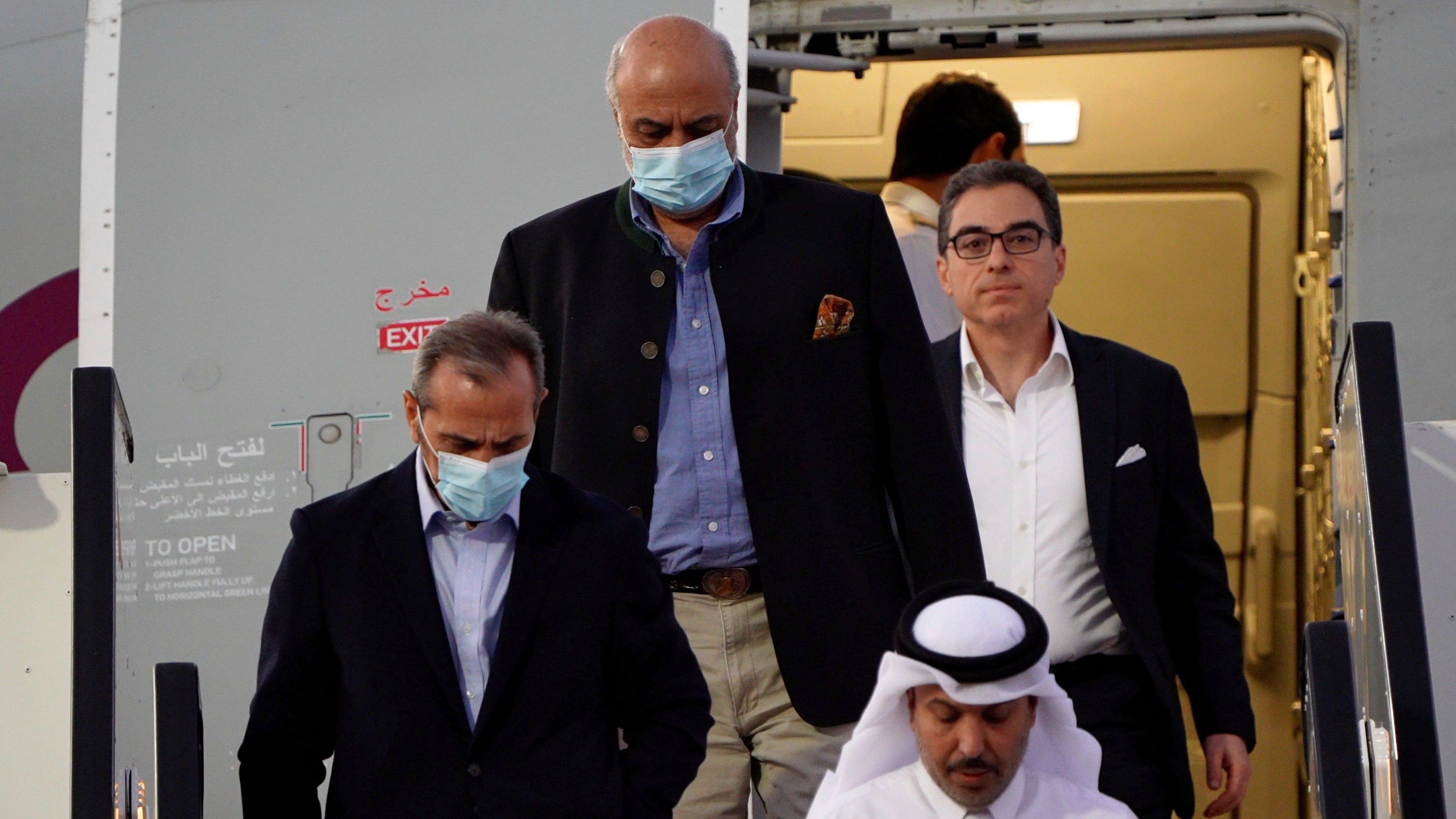
After the plane slowed to a stop in Doha, three of the prisoners walked down the stairs. They hugged the U.S. ambassador to Qatar, Timmy Davis, and others.
The three — Siamak Namazi, Emad Sharghi and Morad Tahbaz — then threw their arms over one another's shoulders and walked off to a building in the airport.
In a statement issued on his behalf, Namazi said: “I would not be free today, if it wasn’t for all of you who didn’t allow the world to forget me.”
“Thank you for being my voice when I could not speak for myself and for making sure I was heard when I mustered the strength to scream from behind the impenetrable walls of Evin Prison,” he said.
The United States did not immediately identify the other two freed Americans, all of whom were released in exchange for five Iranians in U.S. custody and for the deal over the frozen Iranian assets. The Biden administration said the five freed Iranians pose no threat to U.S. national security.
Two of the imprisoned Americans' family members, Effie Namazi and Vida Tahbaz, who had been under travel bans in Iran, also were on the plane. The women, too, clasped arms and kissed on the tarmac in Qatar.
Iranian Foreign Ministry spokesman Nasser Kanaani said two of the Iranian prisoners will stay in the U.S. Meanwhile, Nour News, a website believed to be close to Iran’s security apparatus, said two of the Iranian prisoners were in Doha for the swap.
Nour News identified the two released Iranians in Doha as Mehrdad Ansari, an Iranian sentenced by the U.S. to 63 months in prison in 2021 for obtaining equipment that could be used in missiles, electronic warfare, nuclear weapons and other military gear, and Reza Sarhangpour Kafrani, an Iranian charged in 2021 over allegedly unlawfully exporting laboratory equipment to Iran.
The $5.9 billion in cash released to Iran represents money South Korea owed Iran — but had not yet paid — for oil purchased before the U.S. imposed sanctions on such transactions in 2019.
The U.S. maintains that, once in Qatar, the money will be held in restricted accounts to be used only for humanitarian goods, such as medicine and food. Those transactions are currently allowed under American sanctions targeting the Islamic Republic over its advancing nuclear program.
Iranian government officials have largely concurred, though some hard-liners have insisted, without evidence, that there would be no restrictions on how Tehran spends the money.
The planned exchange comes ahead of the convening of world leaders at the U.N. General Assembly this week in New York, where Raisi will speak.
The deal has already opened Biden to fresh criticism from Republicans and others who say the administration is helping boost the Iranian economy at a time when Iran poses a growing threat to American troops and Mideast allies. That could have implications in his re-election campaign.
Former President Donald Trump, currently the lead Republican challenger in the polls against Biden's 2024 re-election bid, called it an “absolutely ridiculous” deal on the Truth Social social media site. Senate Minority Leader Mitch McConnell accused Biden of “rewarding and incentivizing Tehran's bad behavior.”
Biden held what the White House described as an emotional phone call with the families of the freed Americans after their release.
In his statement, Biden urged Americans not to travel to Iran and demanded more information on what happened to Bob Levinson, an American who went missing years ago. The Biden administration also announced fresh sanctions on former Iranian President Mahmoud Ahmadinejad and the Iranian Ministry of Intelligence.
The U.S. government, the prisoners’ families and activists have denounced the charges against the five Americans as baseless.
The Americans included Namazi, who was detained in 2015 and later sentenced to 10 years in prison on spying charges; Emad Sharghi, a venture capitalist sentenced to 10 years; and Morad Tahbaz, a British-American conservationist of Iranian descent who was arrested in 2018 and also received a 10-year sentence.
In a statement, Sharghi’s sister, Neda, said she “can’t wait to hug my brother and never let him go.”
“This is my brother, not an abstract policy," she added. "We are talking about human lives. There is nothing partisan about saving the lives of innocent Americans and today should be a moment of American unity as we welcome them home.”
U.S. Secretary of State Antony Blinken thanked Qatar, Switzerland, South Korea and Oman for helping make the deal happen. Biden pledged in a statement to keep pressing for “accountability for Iran and other regimes for the cruel practice of wrongful detention.”
Iran and the U.S. have a history of prisoner swaps dating back to the 1979 U.S. Embassy takeover and hostage crisis following the Islamic Revolution. Their most recent major exchange happened in 2016, when Iran came to a deal with world powers to restrict its nuclear program in return for easing sanctions.
The West accuses Iran of using foreign prisoners — including those with dual nationality — as bargaining chips, an allegation Tehran rejects.
Negotiations over a major prisoner swap faltered after then-president Trump unilaterally withdrew America from the nuclear deal in 2018. From the following year on, a series of attacks and ship seizures attributed to Iran have raised tensions.
Iran also supplies Russia with the bomb-carrying drones Moscow uses to target sites in Ukraine in its war on Kyiv, which remains another major dispute between Tehran and Washington.
Gambrell reported from Dubai, United Arab Emirates, and Lee from Washington. Associated Press writers Nasser Karimi and Amir Vahdat in Tehran, Iran; Paul Haven in New York; Ellen Knickmeyer, Eric Tucker and Farnoush Amiri in Washington, and Aamer Madhani and Michelle Phillips in New York contributed.
Updated Sept. 19 at 5:23 a.m. with the latest developments.