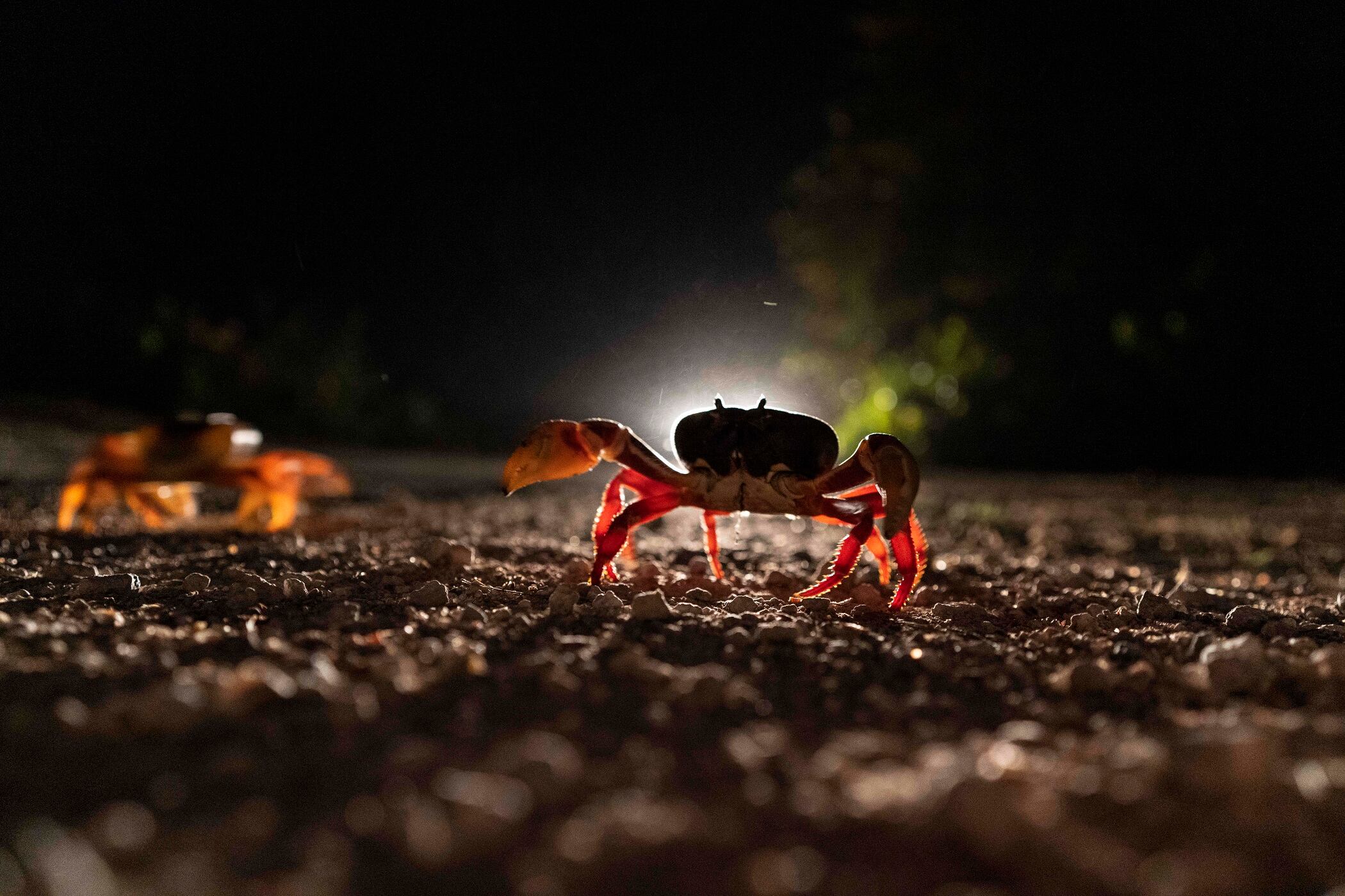
Crabs cross a road in Giron, Cuba, Sunday, April 10, 2022. Millions of crabs emerge at the beginning of the spring rains and start a journey to the waters of the Bay of Pigs to spawn in a yearly migration. (AP Photo/Ramon Espinosa)
Every year in Cuba, millions of crabs emerge from the forest at the beginning of the spring rains and head for the waters of the Bay of Pigs, crossing streets and highways on a perilous journey to mate and reproduce.
Now underway, the migration causes concern to drivers who try to swerve in an often futile attempt not to kill the crustaceans. The crabs are a nuisance to residents but the sight of their road-crossing is a wonder for tourists and other first-time onlookers.
“They got here before us,” said Amaury Urra, a 50-year-old hiking guide who spent his entire life in this part of the Ciénega de Zapata, the largest wetland in the Caribbean, particularly picturesque for the backdrop of turquoise sea waters and the coastal cliffs. ″We’re used to this.″
“Where I live, which is in the center of the town of Girón, the crabs don’t get there as much,″ though there are plenty on the outskirts, he said.
Located about 180 kilometers (110 miles) southeast of Havana, the area was the scene of a 1961 failed invasion by Cuban exiles who signed up for a covertly CIA-funded operation to overthrow Fidel Castro.
This year, the crabs started their journey early. At the end of March, the municipal authorities issued a warning to drivers to avoid traveling in the morning and evening hours - the favorite crossing times for the crabs. Environmentalists usually demand the closure of the main road, especially at key migration times.
The passage of the red crustaceans — the species is called gecarcinus ruricola — could last until July. The largest amount of traffic occurs between April and May. Residents have to be careful: When the crabs feel threatened, they can puncture car tires with their pincers.
Official figures estimate that some 3.5 million crabs die each season on the road, many crushed by passing vehicles. They take a minute and a half to cross.
This type of crab lives and migrates in the Bahamas, Nicaragua, Jamaica and Dominica. But only here, and perhaps in another sector of the coast towards the neighboring province of Cienfuegos, does its path collide so dramatically with human traffic.
An FDA panel has recommended the low-dose Pfizer vaccine for kids ages five to 11. The recommendation now cues up the FDA to authorize the vaccine. Next week, the CDC will consider its own authorization. Once signed off by the CDC, the Pfizer vaccine can be administered in children immediately. Dr. Christina Johns, Senior Medical Advisor at PM Pediatrics, joined Cheddar's Search for a Cure.
Dr. Vivek Cherin, Internal Medicine Physician at Amita Health, joined Cheddar's Search for a Cure to break down what we need to know about eligibility and availability of COVID-19 vaccine boosters.
World leaders will converge this weekend at the 2021 G20 Summit in Rome and the UN COP26 conference in Glasgow with the climate crisis on the agenda. Lord Adair Turner, chair of the Energy Transitions Commission, joined Cheddar to discuss what people can expect to come out of the climate-focused conferences. Turner also noted that one of the biggest hurdles for the attending nations will be coming to a uniform decision on expanding on the Paris Climate Accord goals that have become insufficient to prevent global warming by 1.5 degrees celsius.
Nicole Lambert, President at Myriad Genetics joins ChedHER to discuss how to expand access to genetic testing for all women, and how her experience as a 'pre-vivor' motivates her role in the industry.
Carlo and Baker cover Facebook's big rebrand, the latest on Biden's economic agenda and more. Plus, ranking the best Halloween candy and the worst couple's costumes.
Proptech startup Juno recently raised $20 million in a Series A funding round. The company says the funds will be used to further its mission of building sustainable and affordable apartment buildings across the United States. Juno Co-Founder and CEO Jonathan Sherr joined Cheddar News' Closing Bell to discuss.
Stacey Stevens, President of iCAD, joins 'Cheddar Innovates' to discuss how 'Profound A.I. Risk' works as a short-term breast cancer risk estimation for women.
On this episode of 'Cheddar Innovates': President of iCAD breaks down how its technology is being used as a short-term breast cancer risk estimation for women; A look at Curiosity Stream's 'The Science of Thrills.'
Pharmaceutical company Merck has announced that it will share the formula of its COVID-19 pill with poor countries free of charge. The company still intends to charge wealthier nations leaving the end cost at more than $700 per five-day treatment course.
Dems race for a deal on President Biden's economic agenda ahead of his big foreign trip. What to make of the latest threat assessment in Afghanistan. Plus, the meme cryptocurrency of the moment that's now worth more than many Fortune 500 companies.