By Howard Fendrich
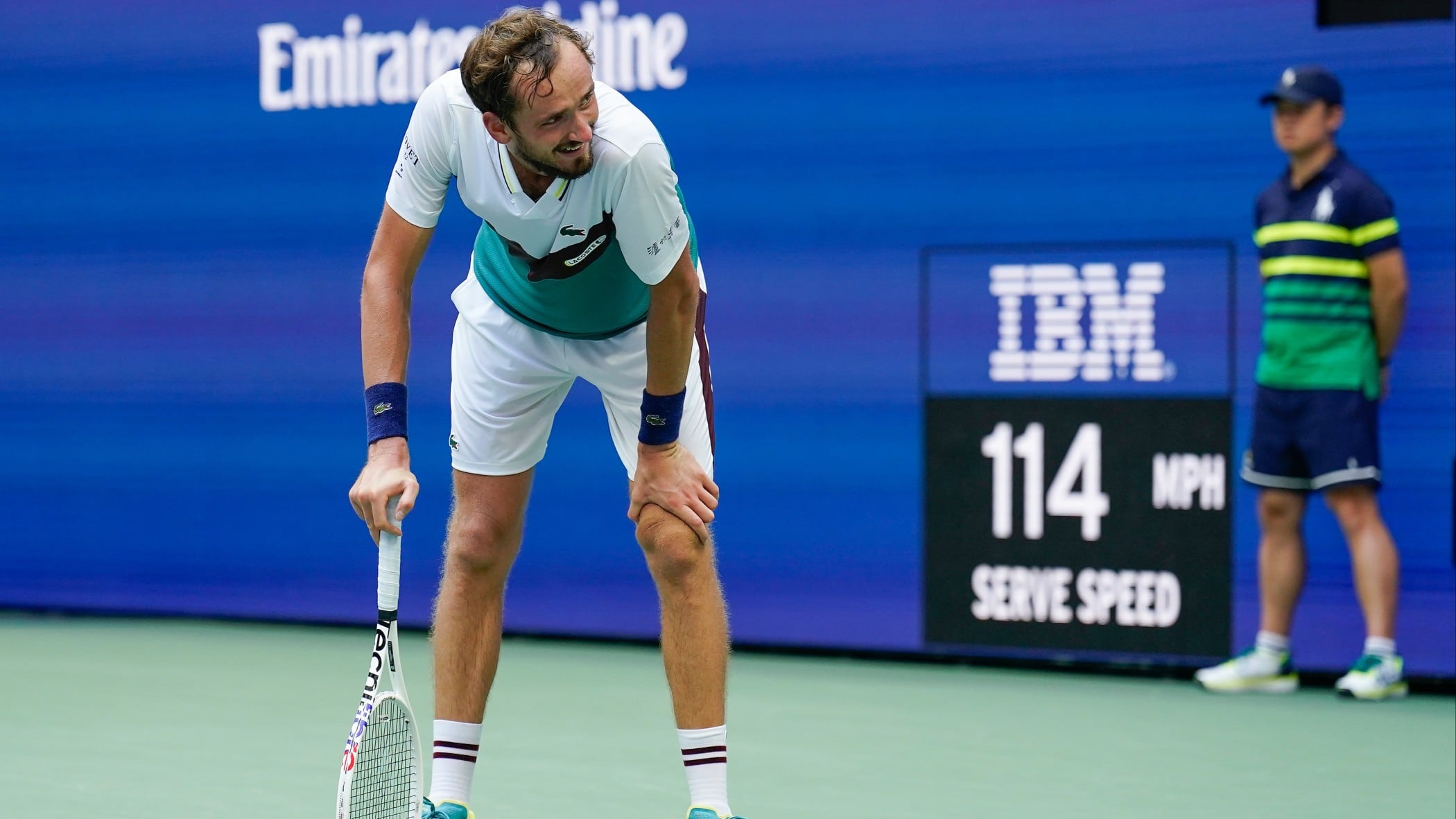
Soaked with sweat as the temperature neared 95 degrees Fahrenheit (35 Celsius) on the hottest day at this year’s U.S. Open, 2021 champion Daniil Medvedev walked slowly to towel off between points of his victory Wednesday, looked into a courtside camera and issued what sounded like a mix between a warning and a plea.
“You cannot imagine," he said. "One player (is) gonna die, and they’re gonna see.”
“The only thing that is a little bit, let’s call it dangerous, is that the question is: How far could we go?” Medvedev, a 27-year-old Russian seeded No. 3, said after eliminating Andrey Rublev 6-4, 6-3, 6-4 to reach the semifinals at Flushing Meadows for the fourth time.
“I’m not sure what can we do. Because probably we cannot stop the tournament for four days — because it’s been, what, three, four days it’s been brutal like this? — because then it basically ruins everything: the TV, even the tickets, everything. It ruins everything,” said Medvedev, who said he needed an ice bath and something to eat after leaving the court. “So I don’t think this could be done.”
An AP analysis shows that it is feeling hotter and hotter at Grand Slam tournaments in recent decades, reflecting the climate change seen in heat waves around the globe this summer. Week 2 at the U.S. Open is pushing players to the limit.
They’re using ice — so much ice, in plastic bags or wrapped in towels — and courtside tubes blowing cold air to try to stay cool.
Medvedev used an inhaler during a second-set changeover Wednesday while being looked at by a doctor, who checked his breathing with a stethoscope. Rublev leaned back on his sideline chair as if he would rather be anywhere else.
“At the end of the first set, I couldn’t see the ball anymore,” Medvedev said, adding that he looked across the net at No. 8 seed Rublev — his countryman, good pal and godfather to his daughter — and thought: “Wow. It seems like he cannot run anymore.”
Medvedev will get back on court on Friday for his semifinal against defending champion Carlos Alcaraz, a 6-3, 6-2, 6-4 winner over 2020 U.S. Open runner-up Alexander Zverev on Wednesday night. Alcaraz saved all five break points he faced and converted all four he earned on Zverev's serve.
The other men’s semifinal is 23-time major champ Novak Djokovic vs. unseeded Ben Shelton.
Medvedev wore a white towel around his neck during the on-court interview at Arthur Ashe Stadium after finishing off the 2-hour, 48-minute match, which is relatively short for a best-of-five-set Grand Slam men's match.
Medvedev said he felt dizzy afterward and that both he and Rublev rubbed their faces raw by toweling off so frequently. Rublev described feeling his heart racing between points.
Asked about his level of concern on a day like that, Rublev said: “I’m not even thinking about my health.”
Under a new rule adopted on Tuesday for the rest of the event, the U.S. Tennis Association partially closed the retractable Ashe roof — normally used to block out rain — to provide some additional protection from the sun for spectators and competitors.
One unintended result: The shadows can make it hard to see the tennis balls as they zip through the air.
Zheng Qinwen, the No. 23 seed who defeated 2022 runner-up Ons Jabeur in her previous match, said that dynamic bothered her during a 6-1, 6-4 loss to Aryna Sabalenka.
Sabalenka won 20 of the initial 24 points to race to a 5-0 lead after just 17 minutes.
She reached the semifinals for the fifth major in a row and will rise from No. 2 to No. 1 in the WTA rankings next week, replacing 2022 U.S. Open champion Iga Swiatek, who exited in the fourth round.
As for the weather? Sabalenka, a 25-year-old from Belarus, said her training base in the United States prepared her well for the heat and humidity, which rose above 50%.
“I mean, it was hot, but because I did my preparation in Florida — I mean, what can be worse than Florida? I mean, in July and June, you know. Not, like, overall,” said Sabalenka, who has dropped a total of just 21 games through five matches over the past 1 1/2 weeks. “So I think that’s really (helping) me today to stay strong and (not) really get tired because of the heat.”
She improved to 7-0 in major quarterfinals as she seeks her second Slam trophy to go alongside the one she won at the Australian Open in January.
In Thursday night’s semifinals, Sabalenka will meet 2017 U.S. Open finalist Madison Keys, an American who saved all nine break points she faced during a 6-1, 6-4 victory over reigning Wimbledon champion Marketa Vondrousova. The other women’s semifinal will be No. 6 Coco Gauff against No. 10 Karolina Muchova; they won their quarterfinals Tuesday.
“It's going to be a lot of hard hitting, not a lot of long points,” said Keys, who lost to Sabalenka at Wimbledon in July. “Just going to try to buckle up and get as many balls back as I can.”
Keys vs. Vondrousova was interrupted for eight minutes at deuce in the first game, when a spectator in the lower level needed medical attention. Keys brought two towels and a bottle of water over to where the fan was being helped. The U.S. Tennis Association said the episode was not heat-related.
Medvedev won nine of his 15 return games against Rublev, who is now 0-9 in major quarterfinals.
Now Medvedev gets some time to try to recover.