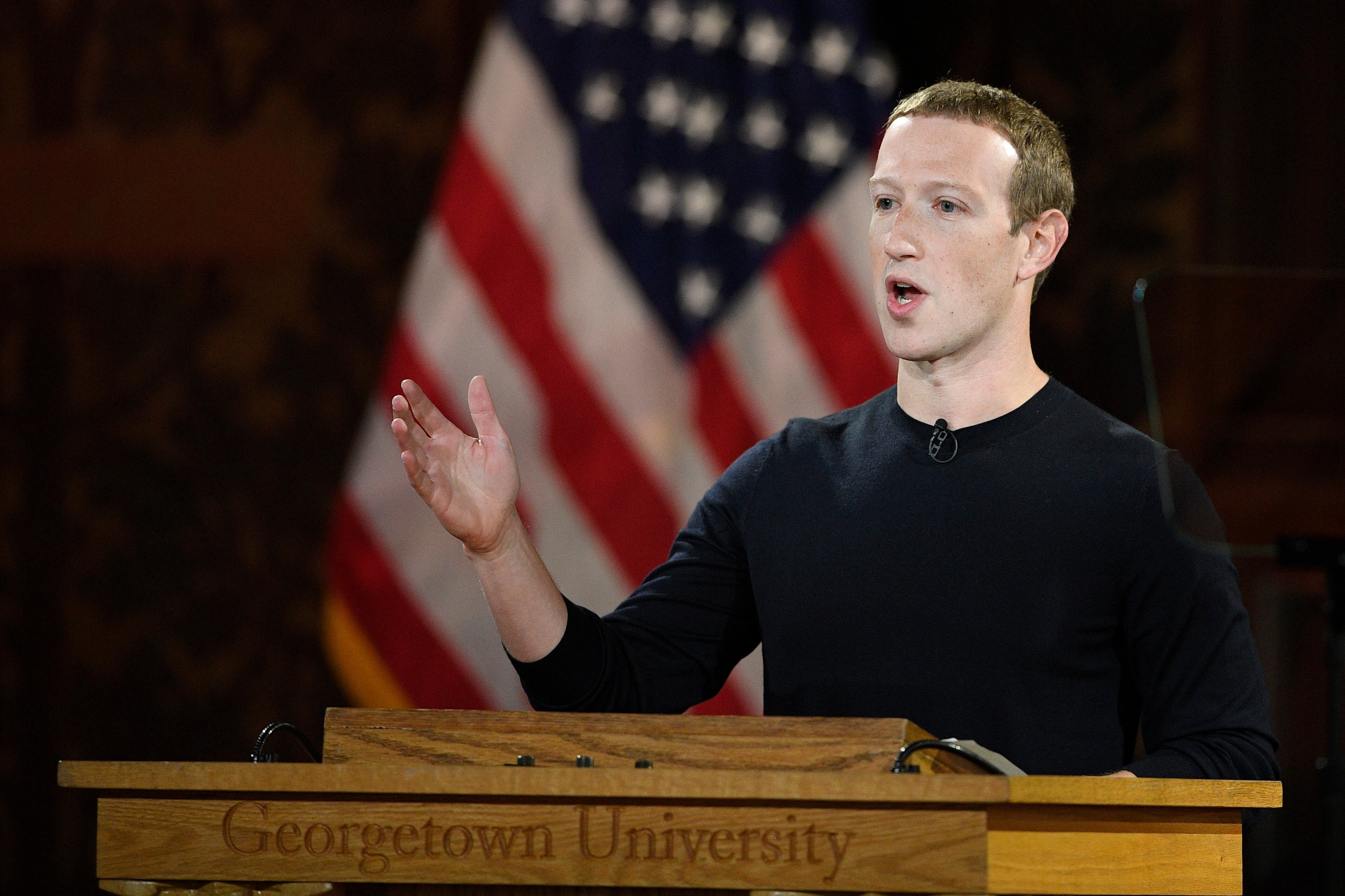
Facebook CEO Mark Zuckerberg on Thursday laid out his most comprehensive take to date on free expression and political speech, ardently saying that social media platforms and society at large should "err on the side of greater expression."
Speaking at Georgetown University, Zuckerberg said he recognized that the U.S. and nations worldwide are facing concerning social tensions but warned against the impulse to restrict free speech online. He also cautioned against placing the responsibility of governing speech in the hands of private corporations.
"We can continue to stand for free expression … or we can decide the cost is simply too great. I am here today to say that we must continue to stand with free expression," Zuckerberg said.
Thursday's speech comes as Facebook — and social media giants at large — continue to come under enormous pressure for allowing misinformation and polarizing speech to disseminate online. Zuckerberg ceded that the issue is significant and needs addressing, especially when it relates to election interference efforts.
Yet private social media companies, Zuckerberg said, should not be tasked with regulating or censoring speech by politicians. The remarks come just weeks after Facebook announced that it will not fact-check posts or advertisements from politicians. Critics widely objected to the decision and urged Facebook to remove or place notices on false political ads, such as those placed recently by President Trump's re-election campaign that stated false claims about a political opponent.
"[Zuckerberg] is in denial and so is his company," Vanita Gupta, president and CEO of The Leadership Conference on Civil and Human Rights, said in a statement Thursday. "Facebook's policy exempting politicians' content from the company's Community Standards … will do irreparable damage to our democracy."
Sen. Elizabeth Warren (D-Mass.), a 2020 presidential candidate, also pressed the issue last week by placing an intentionally false ad on Facebook. Warren slammed the platform for allowing the ad to be posted and said that "when profit comes up against protecting democracy, Facebook chooses profit."
Zuckerberg added Thursday, however, that it is not right "for a private company to censor politicians" in a democracy. He added that voters should hear directly from individuals seeking public office.
Twitter also this week clarified its position on controversial posts from politicians, saying while lawmakers are not "entirely" above the rules, the platform will err on the side of not deleting content.
On misinformation generally, Zuckerberg praised Facebook's enhanced efforts to block hoaxes and false posts that could incite violence, like terrorist acts, or promote criminal activity, such as child exploitation. "We have a responsibility to address these risks," he said.
Facebook should "fight to uphold as wide a definition of freedom of expression as possible — and not allow the definition of what is considered dangerous to expand beyond what is absolutely necessary," Zuckerberg said. "That's what I'm committed to."
Zuckerberg added that his platform will continue its strong vetting of users, as opposed to content. Russian interference in the 2016 election, for instance, was so problematic because the content was posted by fake accounts that coordinated to spread false information, he said. On Facebook, Zuckerberg added, users "can still say controversial things, but you have to stand behind them with your real identity and face accountability."
Overall, the 35-year-old founder said that the impulse to pull back free expression during times of social tension should be resisted. "If we can't agree to let each other talk about the issues, we can't take the first step. Even when it's hard, this is how we build a shared understanding," Zuckerberg said.
Zuckerberg also used Thursday's speech to announce the establishment of an independent oversight board for users to appeal content removal decisions. The board will comprise of a diverse group of experts, all of who "hold free expression as their paramount value."
"Whether you like Facebook or not, we need to recognize what is at stake and come together to stand for free expression at this critical moment," he added.