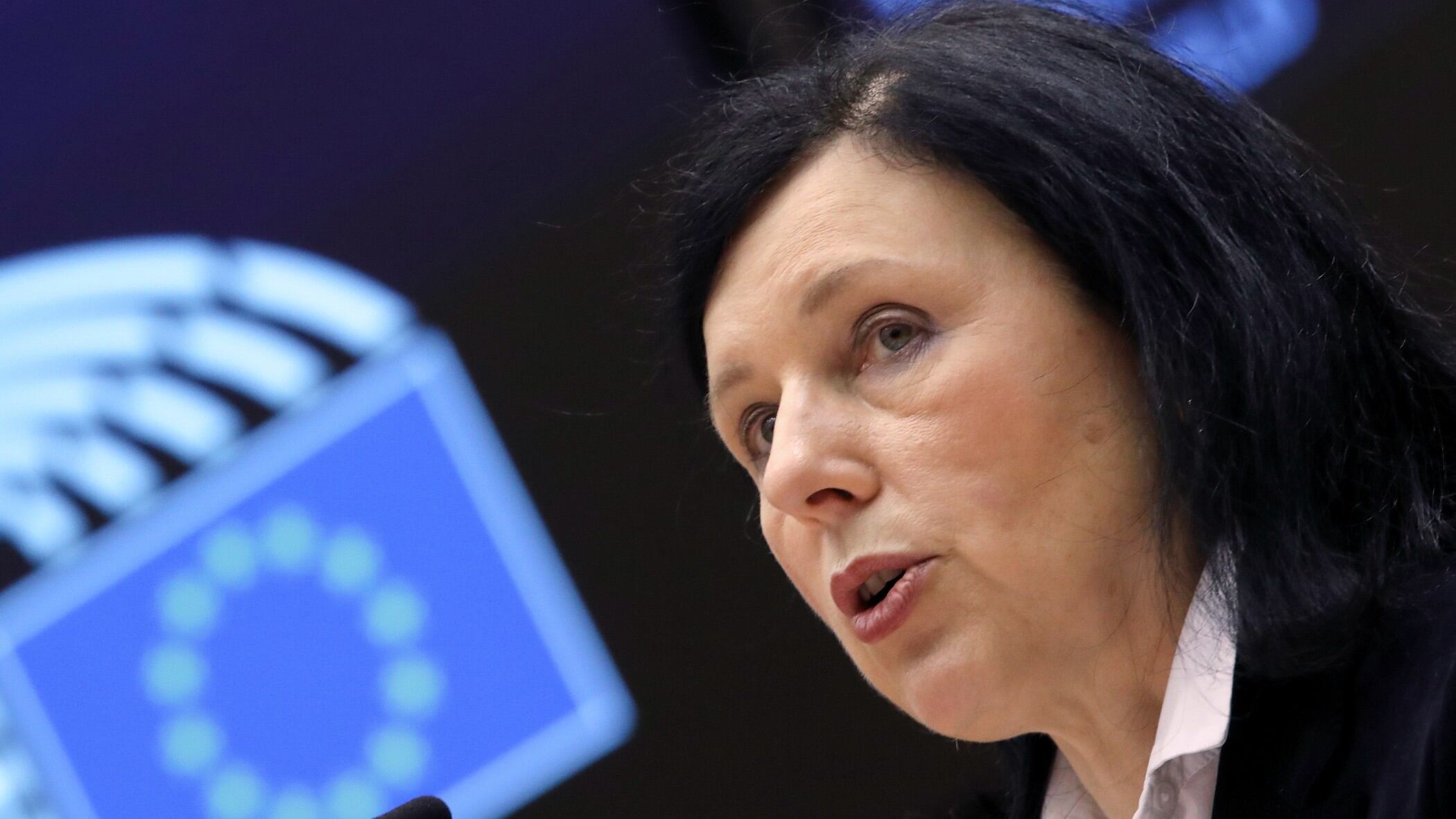
Vera Jourova, EU Commission Vice President, at the European Parliament in Brussels in 2021. The European Union is pushing online platforms like Google and Meta to step up the fight against false information by adding labels to text, photos and other content generated by artificial intelligence, Jourova said Monday.
By Kelvin Chan
The European Union is pushing online platforms like Google and Meta to step up the fight against false information by adding labels to text, photos and other content generated by artificial intelligence, a top official said Monday.
EU Commission Vice President Vera Jourova said the ability of a new generation of AI chatbots to create complex content and visuals in seconds raises “fresh challenges for the fight against disinformation.”
She said she asked Google, Meta, Microsoft, TikTok and other tech companies that have signed up to the 27-nation bloc's voluntary agreement on combating disinformation to work to tackle the AI problem.
Online platforms that have integrated generative AI into their services, such as Microsoft's Bing search engine and Google's Bard chatbot, should build safeguards to prevent “malicious actors” from generating disinformation, Jourova said at a briefing in Brussels.
Companies offering services that have the potential to spread AI-generated disinformation should roll out technology to “recognize such content and clearly label this to users,” she said.
Google, Microsoft, Meta and TikTok did not respond immediately to requests for comment.
Jourova said EU regulations are aimed at protecting free speech, but when it comes to AI, "I don’t see any right for the machines to have the freedom of speech.”
The swift rise of generative AI technology, which has the capability to produce human-like text, images and video, has amazed many and alarmed others with its potential to transform many aspects of daily life. Europe has taken a lead role in the global movement to regulate artificial intelligence with its AI Act, but the legislation still needs final approval and won't take effect for several years.
Officials in the EU, which also is bringing in a separate set of rules this year to safeguard people from harmful online content, are worried that they need to act faster to keep up with the rapid development of generative AI.
Recent examples of debunked deepfakes include a realistic picture of Pope Francis in a white puffy jacket and an image of billowing black smoke next to a building accompanied with a claim that it showed an explosion near the Pentagon.
Politicians have even enlisted AI to warn about its dangers. Danish Prime Minister Mette Frederiksen used OpenAI’s ChatGPT to craft the opening of a speech to Parliament last week, saying it was written “with such conviction that few of us would believe that it was a robot — and not a human — behind it.”
European and U.S. officials said last week that they're drawing up a voluntary code of conduct for artificial intelligence that could be ready within weeks as a way to bridge the gap before the EU's AI rules take effect.
Similar voluntary commitments in the bloc's disinformation code will become legal obligations by the end of August under the EU's Digital Services Act, which will force the biggest tech companies to better police their platforms to protect users from hate speech, disinformation and other harmful material.
Jourova said, however, that those companies should start labeling AI-generated content immediately.
Most digital giants are already signed up to the EU disinformation code, which requires companies to measure their work on combating false information and issue regular reports on their progress.
The exit drew a stern rebuke, with Jourova calling it a mistake.
“Twitter has chosen the hard way. They chose confrontation,” she said. “Make no mistake, by leaving the code, Twitter has attracted a lot of attention, and its actions and compliance with EU law will be scrutinized vigorously and urgently.”
Twitter will face a major test later this month when European Commissioner Thierry Breton heads to its San Francisco headquarters with a team to carry out a "stress test," meant to measure the platform's ability to comply with the Digital Services Act.
Breton, who’s in charge of digital policy, told reporters Monday that he also will visit other Silicon Valley tech companies including OpenAI, chipmaker Nvidia and Meta.
AP reporter Jan M. Olsen contributed from Copenhagen, Denmark.
Inflation remains hot as the January PPI has increased by 1 percent, twice what analysts had been expecting with a jump of 9.7 over the year. Beth Ann Bovino, the U.S. chief economist, for S&P Global Ratings, joined Cheddar News to discuss the rapid pace of inflation alongside higher wages, predicting the Federal Reserve will act quickly and forcefully this year. "They haven't changed their forecast, yet, that's gonna come out soon. But we expect that a March rate hike is basically pretty much baked in the cake," she said. "We think six rate hikes in total for 2022."
For black history month, Cheddar is highlighting black business leaders who are driving the need for representation forward. On February 10, the U.S. Chamber of Commerce hosted an event called 'Developing the Black-Owned Business Ecosystem.' The virtual event was organized under the lobbying group's two initiatives -- the Equality of Opportunity Initiative, and the Coalition to Back Black Businesses. The event highlighted the developments needed to develop more black-owned businesses in the U.S. Dr. Anthony Wilbon, Dean of the School of Business at Howard University, joined Cheddar News' Closing Bell to discuss his experience as a speaker at the event.
A newly declassified letter by senators Ron Wyden and Martin Heinrich claimed the CIA. has been conducting a Secret Surveillance Program which has been collecting a bulk of data from American citizens. The letter which was written in April of 2021 urges the CIA to come clean about the kind of data it collects and how many Americans have been impacted. According to these two senators, the program did not have the safeguards of congressional oversight.
Art Hogan, Chief Market Strategist at National Securities, joined Cheddar News' Closing Bell, where he says investors are taking a wait-and-see approach when it comes to the situation between Russia and the Ukraine and elaborates on the impact higher oil prices stemming from the conflict would have on the market.
Last week, Senators Ron Wyden of Oregon and Martin Heinrich of New Mexico, Democrats on the Senate Intelligence Committee, wrote a a letter airing concerns that the CIA is collecting the data of American citizens without their consent. The lawmakers fear that the program might be exploiting private data. Morgan Wright, the chief security advisor at cybersecurity firm SentinelOne, joined Cheddar News to discuss the ramifications of the letter. "We don't have all the dots in one place to connect them," said Wright, cautioning against jumping to conclusions.
Russian President Vladimir Putin and his Foreign Minister Sergey Lavrov said that diplomacy is still possible, while U.S. officials warn that an attack on Ukraine is imminent. Cheddar News speaks with James Astill, Washington bureau chief of The Economist on the latest developments in Eastern Europe.
As the number of Russian troops rose to 130,000 along its Ukrainian border, hopes for a diplomatic solution remain among world leaders. Jason McMann, head of geopolitical risk analysis at Morning Consult, joined Cheddar News to break down the fluid situation. "We saw signs pointing towards an increase in tensions between Ukraine and Russia, whereas today we're seeing some signs that the Russian government may be willing to continue down a path of diplomatic negotiations to try and find some sort of non-military solution," he said.
Nancy Pelosi and House Democratic leaders are now planning to amend the stop trading on congressional knowledge act, otherwise known as the 'Stock' Act. This 2012 law governs how members disclose the purchase or sale of stocks and amending it would close a loophole, eliminating the trading of individual stocks by members of congress. Pelosi has consistently opposed a ban on stock trading by lawmakers and congressional staff...so what's changed? Kedric Payne, Vice President of Campaign Legal Center, joins Cheddar News to discuss.
In a 5-4 vote, the U.S. Supreme Court allowed for a controversial new version of the Alabama congressional map to remain in place. The lower court had previously ordered that the state must redraw that congressional map because it violates the Voting Rights Act by diluting the political power of Black voters. Redistricting expert Yurij Rudensky joins Cheddar News to weigh in.