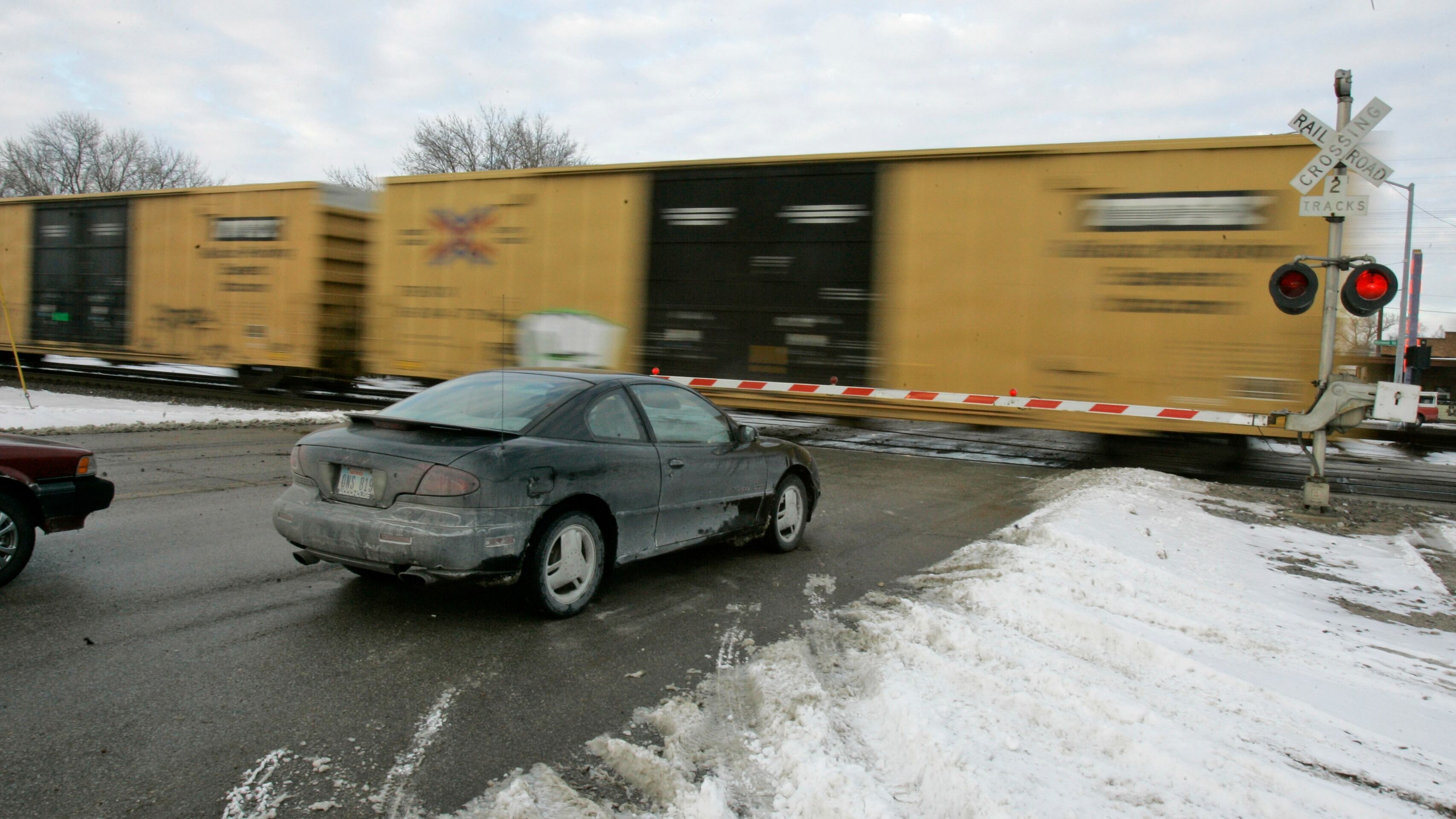
Cars wait for a train to pass, in Valley, Neb., Wednesday, Jan. 17, 2007. With the rail industry relying on longer and longer trains to cut costs, the Biden administration is handing out $570 million in grants to help eliminate railroad crossings in 32 states. The grants announced Monday, June 5, 2023 will help eliminate more than three dozen crossings that delay traffic and sometimes keep first responders from where help is desperately needed. (AP Photo/Nati Harnik, File)
By Josh Funk
With the rail industry relying on longer and longer trains to cut costs, the Biden administration is handing out $570 million in grants to help eliminate many railroad crossings in 32 states.
The grants announced Monday will contribute to building bridges or underpasses at the sites of more than three dozen crossings that delay traffic and sometimes keep first responders from where help is desperately needed.
In some places, trains routinely stretching more than 2 miles (3.2 km) long can block crossings for hours, cutting off access to parts of towns and forcing pedestrians to attempt the dangerous act of climbing through trains that could start moving without warning.
“We see countless stories of people unable to get to work on time, goods being blocked from getting where they need to be and first responders being delayed by these these trains that can be slowed or stopped — even seeing images of children having to crawl between or under freight trains in order to get to school,” U.S. Transportation Secretary Pete Buttigieg said.
In one case Buttigieg mentioned, a Texas mom called 911 because her 3-month-old baby was in distress, but an idle train kept the ambulance from getting there quickly and the baby died at the hospital two days later.
In addition to problems associated with blocked crossings, roughly 2,000 collisions are reported at railroad crossings every year. Nearly 250 deaths were recorded last year in those car-train crashes. In one instance Buttigieg cited, a woman in California wound up stopped on the tracks after traffic backed up and she was killed when a train slammed into her vehicle.
In recent years, the major freight railroads have overhauled their operations to rely on fewer, longer trains so they can use fewer crews and locomotives as part of efforts to cut costs.
The railroads insist those changes haven't made their trains riskier, but regulators and Congress are scrutinizing their operations closely after several recent high-profile derailments. And the problems at rail crossings are well documented.
These grants are part of $3 billion in funding approved in the $1 trillion infrastructure law for these rail crossing projects that will be doled out over the next five years.
A number of the 63 projects that will receive grants involve only planning and design work for eliminating crossings in the future, but most of the money will go toward physical improvements at crossings and eliminating longstanding problems.
Buttigieg said he plans to visit Grand Forks, North Dakota, Monday to highlight a $30 million grant helping to pay for a project near the University of North Dakota campus that will improve access to the local hospital.
A grant worth nearly $37 million will help eliminate four rail crossings in Houston, which has the second-highest number of rail crossing deaths in the nation. The four new underpasses to be built will reduce traffic delays and improve pedestrian safety.
One $7.2 million grant will help improve access to an area of Fostoria, Ohio, known as the Iron Triangle because it is bordered on three sides by train tracks. A CSX train passes through the community about once every 26 minutes, with warning sirens at the crossings sounding for at least two hours daily. A new bridge will be built over the tracks on one side of the neighborhood to provide a safe route into the area.
In each of these grants, states and cities — sometimes with the help of the railroads — must cover at least 20% of the project cost.
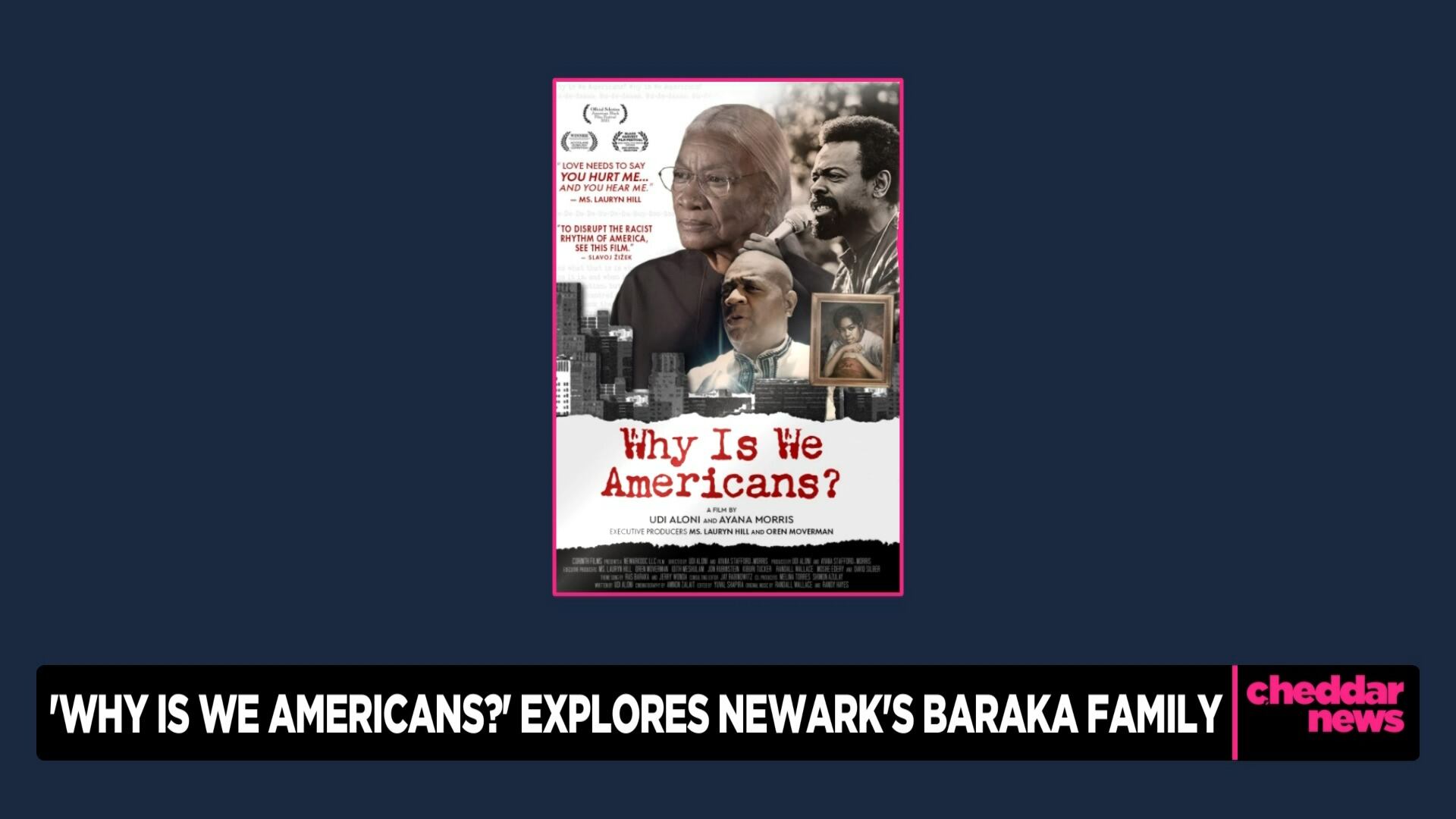
Mayor Ras Baraka of Newark, NJ and Ayana Morris, co-director of the documentary 'Why Is We Americans?,' join Cheddar News to discuss the new documentary highlighting the impact of the Baraka family.
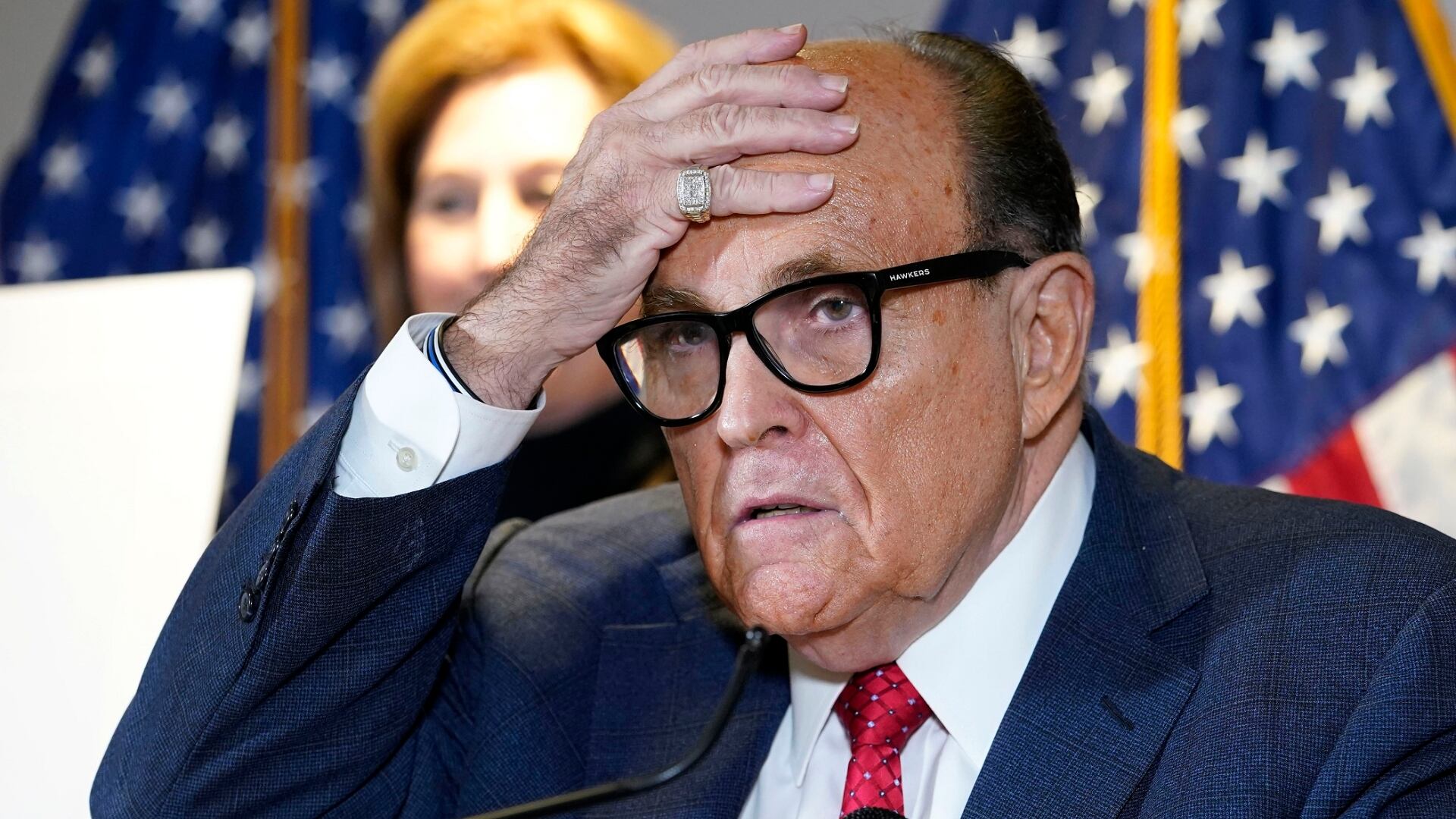
Former New York City mayor and lawyer to Donald Trump Rudy Giuliani made his singing debut on a taping of Fox’s The Masked Singer. However, Ken Jeong and Robin Thicke, two judges on the competition show, reportedly left in protest when Giuliani was unmasked upon being eliminated.
All Hands celebrates Black History Month by highlighting achievements in inclusivity and paying homage to those who have fought for equal rights. Rep. Maxine Waters (D-CA) joins Cheddar News to discuss voter suppression; Damali Peterman, CEO of Breakthrough ADR, elaborates on the biggest barriers for Black professionals; Andre Perry, senior fellow of Brookings Institution, dives into student loans and the racial wealth divide; and lastly, BET CEO Scott Mills discusses the company's initiatives for 2022.
All month long Cheddar News is celebrating Black History Month.
In our nation’s capital, Black history is being made right now.
cheddar's own Arielle Hixon puts the spotlight on three lawmakers making that happen, Rep. Lauren Underwood (D-IL), Rep. Cori Bush (D-MO), and Sen. Tim Scott (R-SC).
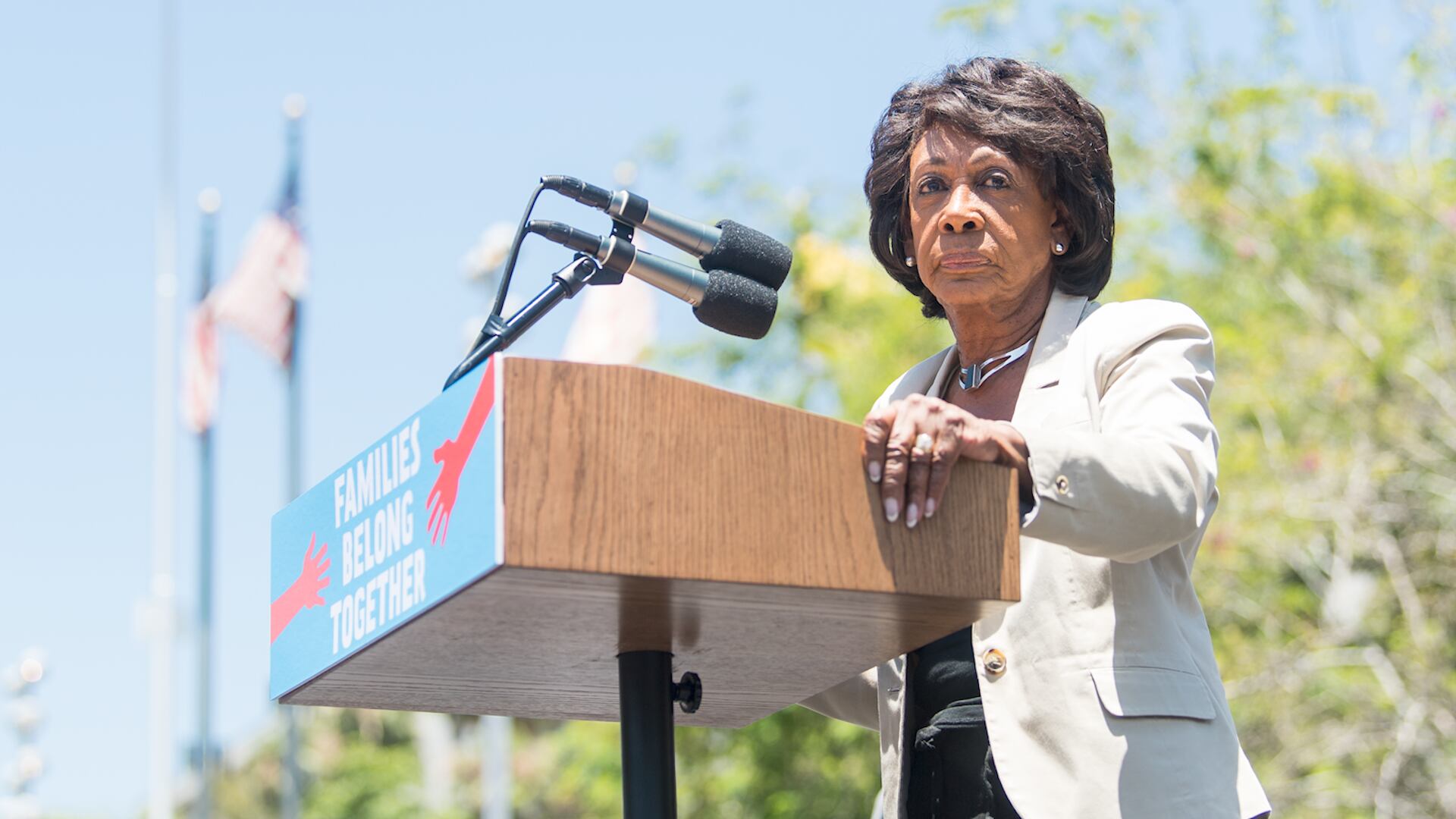
Representative Maxine Waters (D-Calif. 43rd District) joined Cheddar News to talk about the current political climate in America, including efforts to roll back voting rights in multiple states in light of Black History Month. "Why do we have to deal with those who still believe that somehow this country only belongs to the whites of the country and that somehow they have to do everything that they can to undermine our voting and do voters suppression to keep us from being influential and at the table by which to solve problems?" she asked. Waters chided "two Democrats" who she said were stymying attempts to rectify the issue and also spoke on President Biden’s promise to nominate a Black woman to the Supreme Court.
Wall Street saw another volatile day after the Federal Reserve left rates unchanged for now, with plans to raise rates in March at its next meeting in order to ease inflation. Fed Chair Jerome Powell said the Fed has not made decisions on the size of rate increases, adding that the Fed is not trying to get inflation below two-percent. Ken Johnson, CFA and Investment Strategy Analyst explains why Powell thinks that high inflation is a significant threat to the labor market.
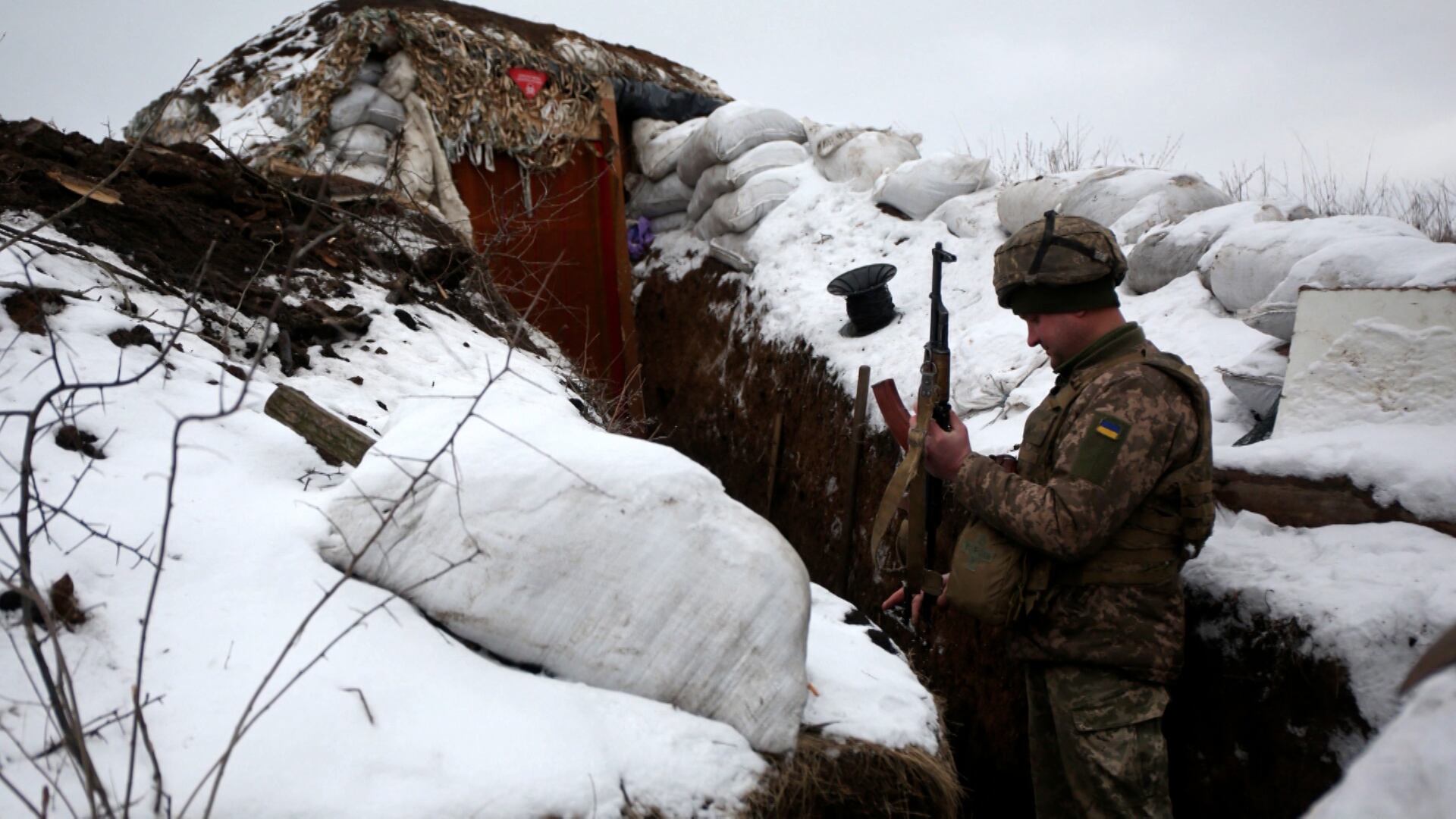
Anu Gaggar, global investment strategist for Commonwealth Financial Network, joined Cheddar News to discuss how global supply chains could be disrupted even further by an armed conflict in Ukraine.
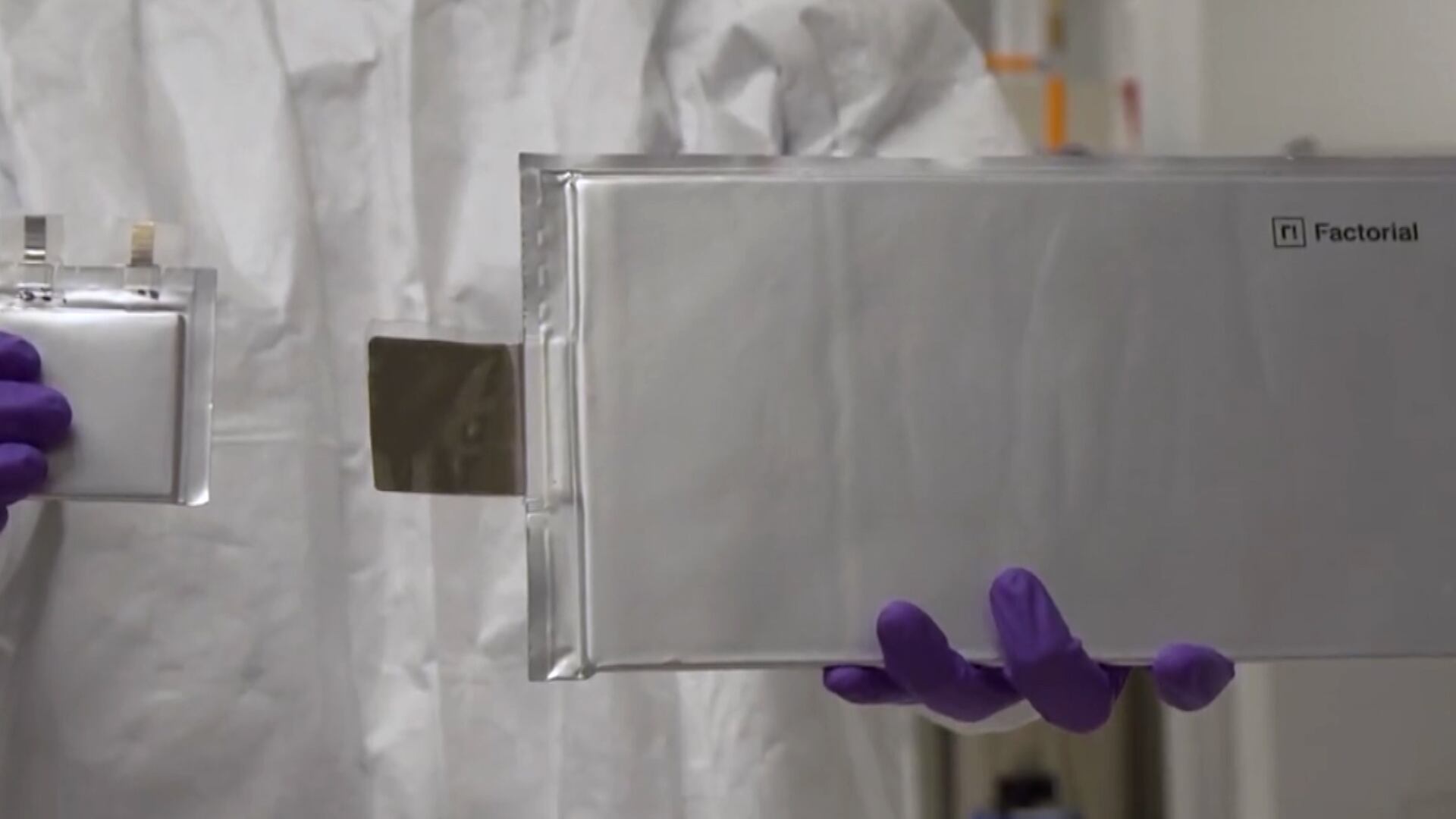
Solid-state battery maker Factorial Energy recently raised $200 million in a Series D round led by Mercedes-Benz and Stellantis. Factorial says the funding will be used to accelerate commercial production and deployment of its solid-state battery technology, which the company says is safer, and offers up to 50% more driving range than current lithium-ion technology. Factorial also has joint development agreements (announced in late 2021) with Mercedes-Benz, Stellantis, and Hyundai, three of the top 10 global automotive manufacturers, to commercialize its batteries. Factorial CEO Siyu Huang joined Cheddar News' Closing Bell to discuss.