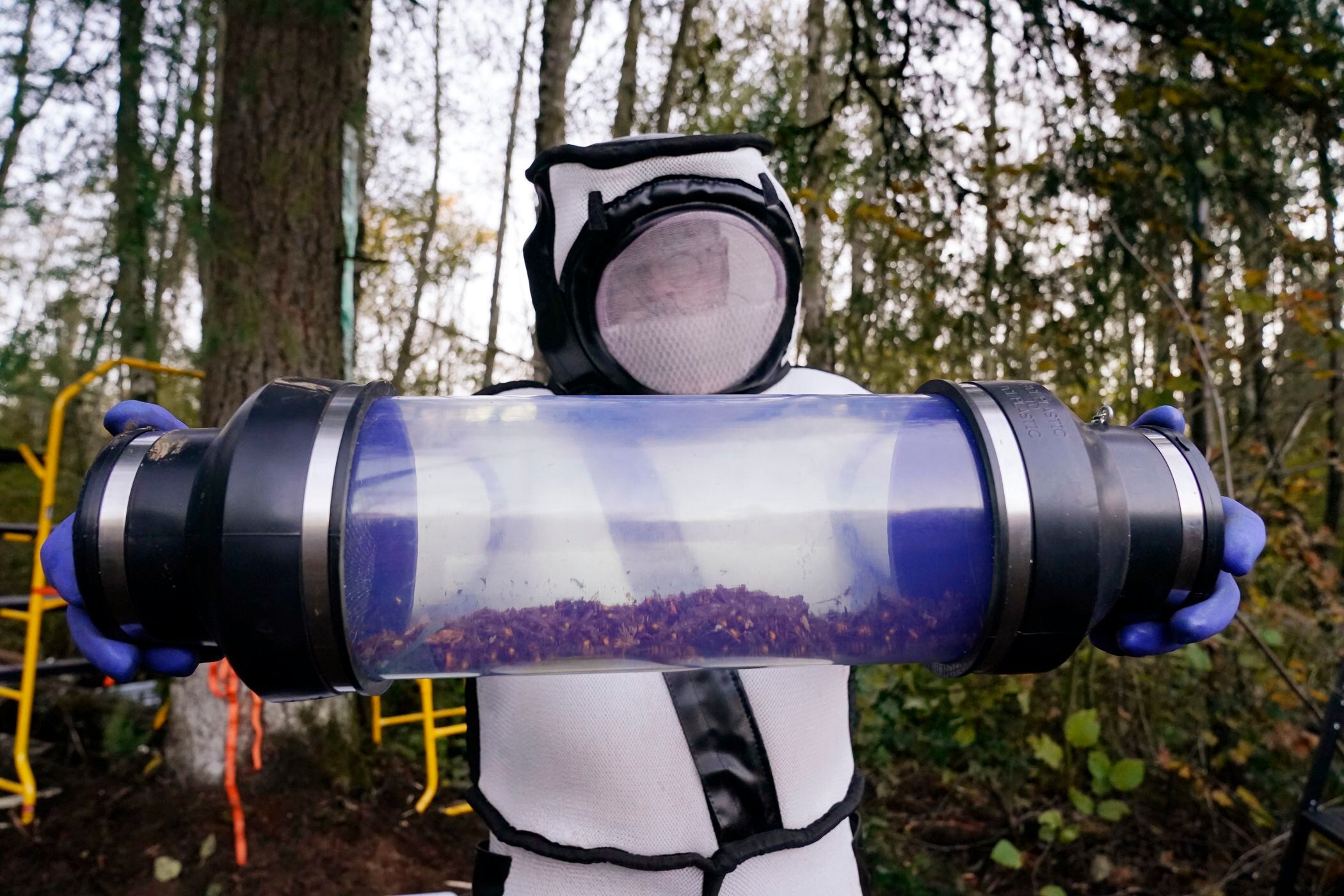
Sven Spichiger, Washington State Department of Agriculture managing entomologist, displays a canister of Asian giant hornets vacuumed from a nest in a tree behind him Saturday, Oct. 24, 2020, in Blaine, Wash. Scientists in Washington state discovered the first nest earlier in the week of so-called murder hornets in the United States and worked to wipe it out Saturday morning to protect native honeybees. Workers with the state Agriculture Department spent weeks searching, trapping and using dental floss to tie tracking devices to Asian giant hornets, which can deliver painful stings to people and spit venom but are the biggest threat to honeybees that farmers depend on to pollinate crops. (AP Photo/Elaine Thompson)
Heavily protected crews in Washington state worked Saturday to destroy the first nest of so-called murder hornets discovered in the United States.
The state Agriculture Department had spent weeks searching, trapping, and using dental floss to tie tracking devices to Asian giant hornets, which can deliver painful stings to people and spit venom but are the biggest threat to honeybees that farmers depend on to pollinate crops.
The nest found in the city of Blaine near the Canadian border is about the size of a basketball and contained an estimated 100 to 200 hornets, according to scientists who announced the find Friday.
Crews wearing thick protective suits vacuumed the invasive insects from the cavity of a tree into large canisters Saturday. The suits prevent the hornets' 6-millimeter-long stingers from hurting workers, who also wore face shields because the trapped hornets can spit a painful venom into their eyes.
The tree will be cut down to extract newborn hornets and learn if any queens have left the hive already, scientists said. Officials suspect more nests may be in the area and will keep searching. A news briefing was planned Monday on the status of the nest.
Despite their nickname and the hype that has stirred fears in an already bleak year, the world’s largest hornets kill at most a few dozen people a year in Asian countries, and experts say it is probably far less. Meanwhile, hornets, wasps, and bees typically found in the United States kill an average of 62 people a year, the Centers for Disease Control and Prevention has said.
The real threat from Asian giant hornets — which are 2 inches (5 centimeters) long — is their devastating attacks on honeybees, which are already under siege from problems like mites, diseases, pesticides, and loss of food.
The invasive insect is normally found in China, Japan, Thailand, South Korea, Vietnam, and other Asian countries. Washington state and the Canadian province of British Columbia are the only places the hornets have been found on the continent.
The nest was found after the state Agriculture Department trapped some hornets this week and used dental floss to attach radio trackers to some of them.
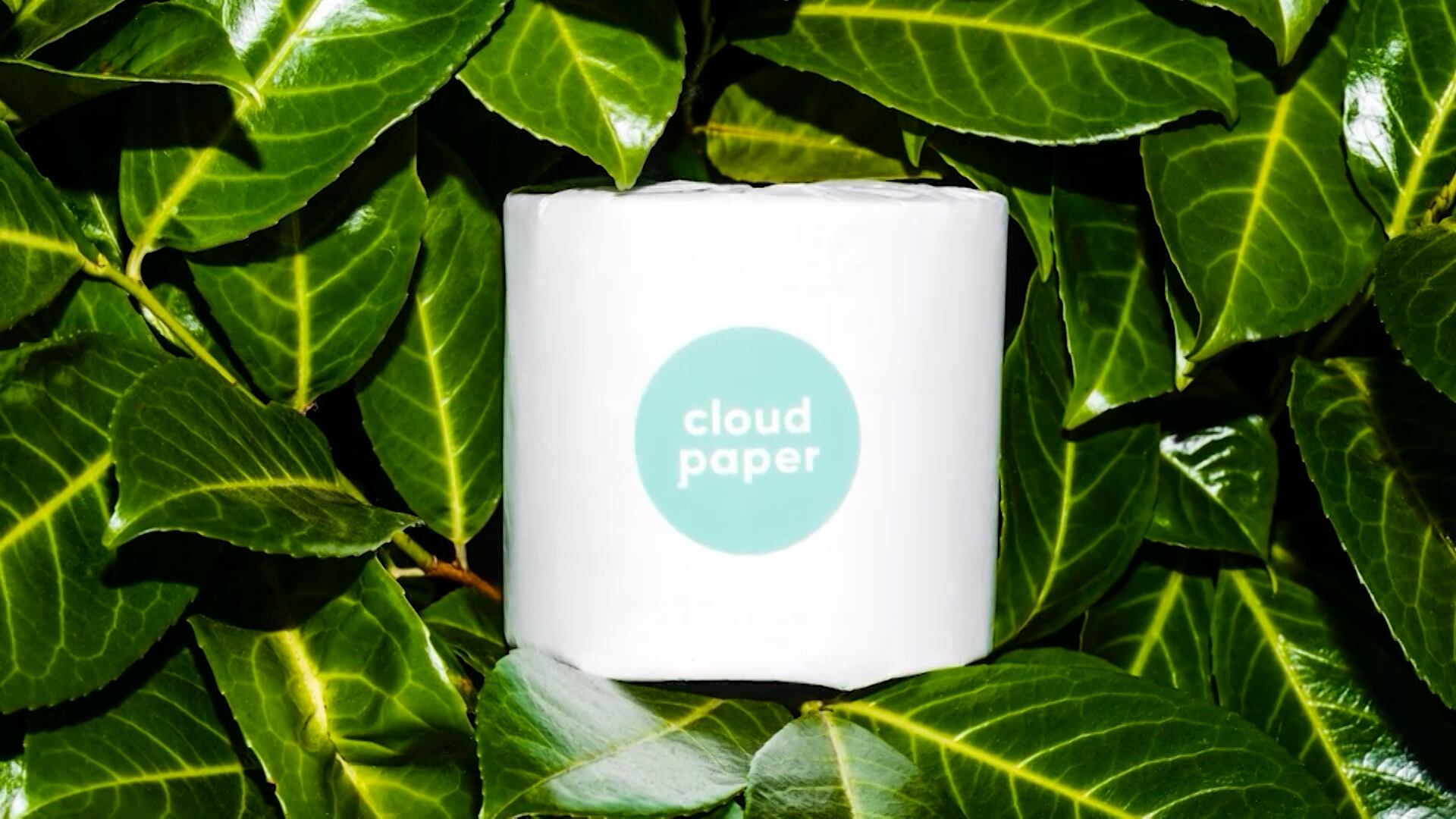
Bamboo-based toilet paper company Cloud Paper raised $5 million in a recent funding round. Its product is a bamboo-based alternative to traditional toilet paper made from trees, and its mission is to end the deforestation caused by traditional paper products. Cloud Paper says the raise will allow it to make significant investments in its supply chain, product development, and hiring. Ryan Fritsch, a co-founder of Cloud Paper, joined Cheddar News' Closing Bell to discuss.
Space tourism company World View plans to launch its first commercial flights in early 2024, with voyages to take off from iconic locations around the world like the Grand Canyon — but seemingly at a flexible price point. Dale Hipsh, president of tourism and exploration at World View, joined Cheddar to discuss what a trip to the stratosphere would look like with his company and its much less expensive take on space travel. "Our technology allows us to be more democratic, to offer more opportunities for people to experience near space, and that overview effect," he said. "So we're really thrilled to be bringing it to market."
A recent NOAA report found America's coastline could experience a century's worth of sea rise in just 30 years. By 2050, water on the U.S. coast will be 10-12 inches higher, causing major eastern cities to be hit regularly with floods, even on sunny days. Gary Mitchum, professor of physical oceanography at the University of South Florida, joins Cheddar News to discuss.
The Biden administration is launching a new task force to promote the use of 'cleaner' construction materials with lower life cycle emissions. This comes as the White House works to speed up government purchases of greener products. Sweta Chakraborty, climate change expert and U.S. president of "We Don't Have Time," joins Cheddar News to discuss.
Stephen Gardner, director at ETF Managers Group, explains why investors shouldn't be rushing to sell vaccine stocks like Moderna or BioNTech even as the spread of COVID-19 slows down.
On this episode of Cheddar Innovates: Evolution Devices CEO breaks down how the Evowalk wearable device can help those with walking impairments; Cresilon CEO explains how he's created a plant-based gel to easily treat wounds in both humans and animals; A look at Curiosity Stream's 'The Colorado Problem.'
Pier Mantovani, Founder and CEO of Evolution Devices, joins Cheddar Innovates to discuss how the Evowalk wearable device can help those with walking impairments, and how remote physical therapy is becoming a reality.
Joe Landolina, CEO and Co-Founder of Cresilon, joins Cheddar Innovates to discuss how he's created a plant-based gel to easily treat wounds in both humans and animals.
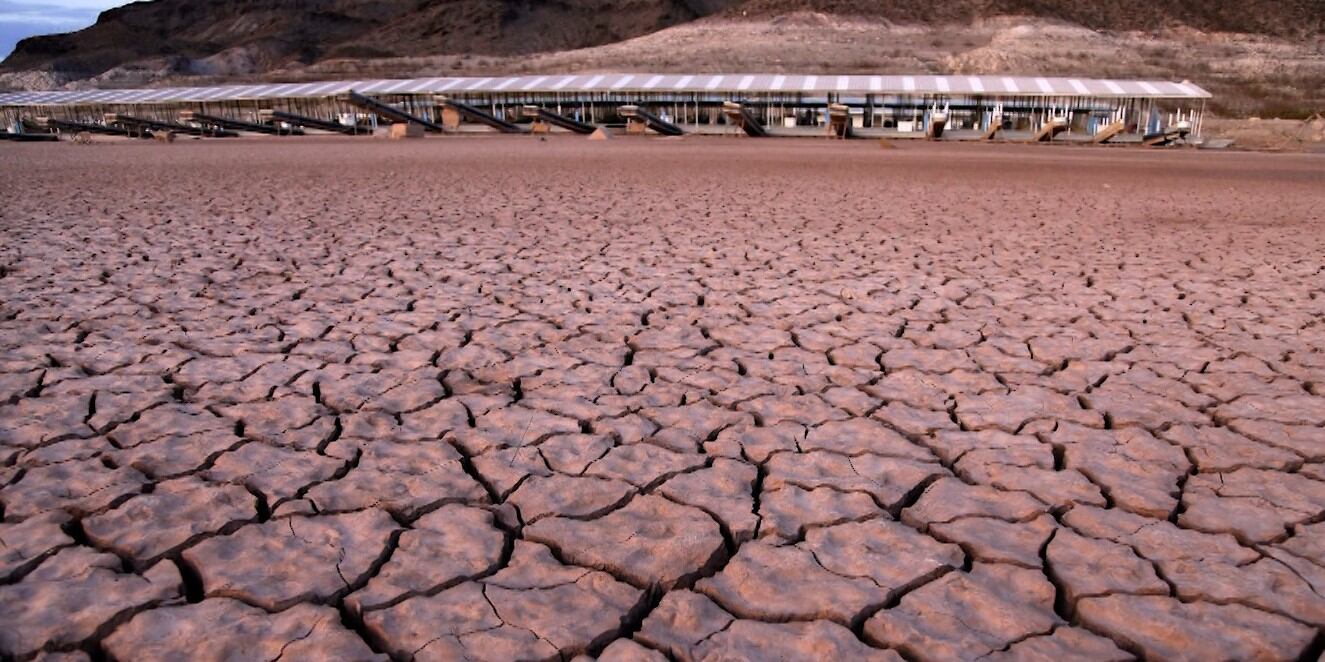
A new analysis reveals that for more than two decades, the West has been the driest it has ever been since 800 A.D. The drought which began in 2000 has brought more devastating wildfires and draining water reserves well below healthy levels. Climate Scientists and Adjunct Associate Research Scientist at Lamont Doherty Earth Observatory at Columbia University,Benjamin Cook, joined Cheddar to discuss more.