By Howard Fendrich
Coco Gauff is still a teenager, after all, and so it should surprise no one that she was on her phone in the locker room, scrolling through social media, right up until 10 minutes before heading out on court for the U.S. Open final.
What the 19-year-old from Florida was reading, she would say later, were various comments, negative ones, “saying I wasn't going to win today; that just put the fire in me.”
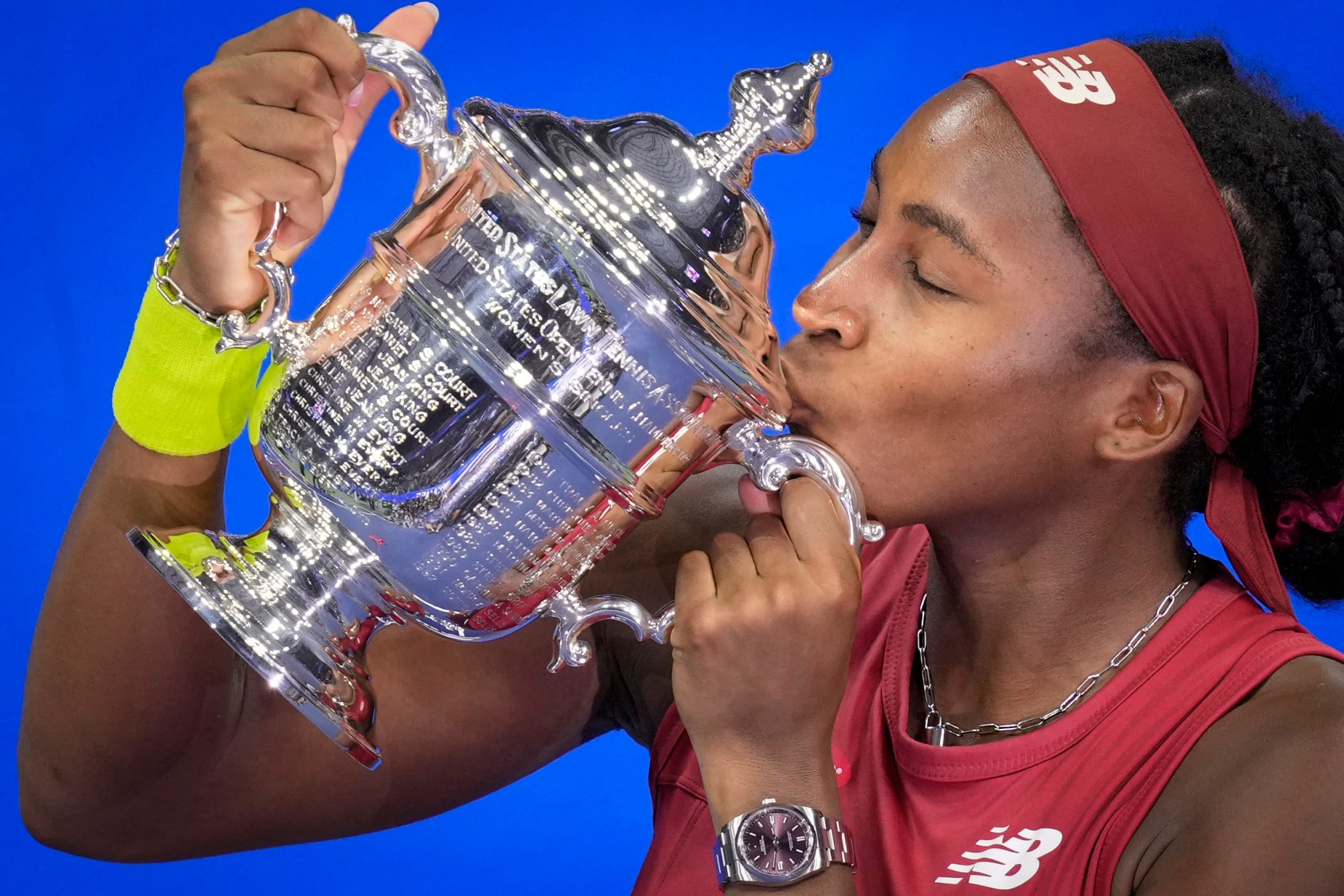
As a pro athlete from a young age, as someone of whom greatness has been expected by some and doubted by others, Gauff has always taken it all in and kept moving forward, trying to learn from each setback. And now, at a tournament she used to visit as a kid to see her idols, Serena and Venus Williams, Gauff is a Grand Slam champion herself and a certified star.
Setting aside a so-so start Saturday, Gauff surged to a 2-6, 6-3, 6-2 victory over the soon-to-be-No. 1 Aryna Sabalenka in the final at Arthur Ashe Stadium, delighting a raucous crowd that backed her from start to finish.
When Gauff walked into her news conference — phone in hand, of course — she noticed that a large screen on the back wall was rotating pictures of her from the match. So she tucked her new silver trophy under one arm and used the other hand to snap a selfie with those photos in the background.
“Right now I’m just feeling happiness and a very, very small bit of relief,” she explained. “Because honestly, at this point, I was doing it for myself and not for other people.”
Gauff, who is from Florida, is the first American teenager to win the country’s major tennis tournament since Serena Williams in 1999. If last year’s U.S. Open was all about saying goodbye to Williams as she competed for the final time, this year’s two weeks in New York turned into a “Welcome to the big time!” moment for Gauff. Famous people were coming to watch her play, including former President Barack Obama, who was among those sending congratulatory wishes on Saturday. Also, Gauff and her parents received a congratulatory phone call from President Joe Biden, who was in New Delhi for the Group of 20 summit.
Gauff burst onto the scene at 15 by becoming the youngest qualifier in Wimbledon history and making it to the fourth round in her Grand Slam debut in 2019. She reached her initial major final at last year’s French Open, finishing as the runner-up to Iga Swiatek, a loss that stung.
“I watched Iga lift up that trophy, and I watched her the whole time," Gauff recalled. "I said, ‘I’m not going to take my eyes off her, because I want to feel what that felt like for her.’”
Another down moment came this July at the All England Club, where she exited in the first round. Since then, she has won 18 of 19 matches, and now 12 in a row, while working with a new coaching pair of Brad Gilbert and Pere Riba.
The No. 6-seeded Gauff did it Saturday by withstanding the power displayed by Sabalenka on nearly every swing of her racket, eventually getting accustomed to it and managing to get back shot after shot. Gauff broke to begin the third set on one such point, tracking down every ball hit her way until eventually smacking a putaway volley that she punctuated with a fist pump and a scream of “Come on!”
Soon it was 4-0 in that set for Gauff. Didn't take long for her to close it out, then drop to her back on the court, before climbing into the stands to find her parents.
“You did it!” Gauff's mom told her, both in tears.
In addition to her trophy, Gauff was handed an envelope with the champion's $3 million paycheck, the same amount Novak Djokovic or Daniil Medvedev will get after the men's final Sunday. This is the 50th anniversary of when the 1973 U.S. Open became the first major sports event to pay women and men equal prize money; the person who led that effort, Hall of Fame player and rights advocate Billie Jean King, was on hand Saturday.
“Thank you, Billie," Gauff said, "for fighting for this.”
Sabalenka came in 23-2 at majors in 2023, including a title at the Australian Open. The 25-year-old from Belarus already was assured of rising from No. 2 to No. 1 in the rankings next week (Gauff will be No. 3 in singles, No. 1 in doubles).
That ranking milestone is “why I’m not super depressed right now,” Sabalenka said, then joked: “I’m definitely going to be. I’m definitely going for a drink tonight — if I’m allowed to say that.”
She was reduced to the role of foil by the fans in 23,000-capacity arena. Setting the tone, Gauff's pre-match TV interview, shown in the arena, was drowned out by the sound of applause and yells reverberating off the closed retractable roof.
Winners by Gauff were celebrated as if the match were over. So were Sabalenka’s miscues. When Sabalenka heard cheers during the post-match ceremony, she joked: “You guys could have supported (me) like this during the match.”
By the end, she had 46 unforced errors, Gauff 19. Here’s another way to view it: Gauff only needed 13 winners to accumulate 83 points.
“Sometimes, I can get emotional,” Sabalenka said. “Today on the court, I was overthinking and I was missing ... balls I shouldn’t be missing.”
When Sabalenka has everything calibrated just right, it’s difficult for any foe to handle it — even someone as speedy, smart and instinctive as Gauff, whose get-to-every-ball court coverage kept points alive.
Sabalenka credited Gauff's superb defense — “definitely, she was moving just unbelievable” and "I always had to play like an extra ball" — but also thought many mistakes were “more about me than her. I lost this match.”
When Sabalenka was on-target early, she dominated. During a four-game run to close the opening set, one thrilling point had the audience making noise before it was over. Gauff scrambled to get Sabalenka’s strokes back, including somehow deflecting a booming overhead, before a second, unreachable overhead bounced into the seats.
Sabalenka raised her left hand and wagged her fingers, telling spectators to give her some love.
But soon, Gauff was playing better, Sabalenka was off-target more, and the love was being showered only on one of them, the sport’s newest Grand Slam champion.
“Many more to come,” Sabalenka said, “I’m pretty sure.”
That will now be the pressure placed on Gauff: When's the next one? That's no easy burden. Consider: Two of the previous four U.S. Open women's champions were teens at the time, Bianca Andreescu in 2019 and Emma Raducanu in 2021, and neither has come close to replicating that success yet.
Gauff's maturity on and off a court should help her now as much as ever.
“I have just been embracing every positive and negative thing that’s said about me. I realize sometimes people have different personalities and some people need to shut off the comments and not look at them. But I’m an argumentative person. I’m very stubborn,” said Gauff, who chatted with her boyfriend until 1 a.m. the night before the biggest match of her life so far. “My parents know: If they tell me one thing, I like to do the other.”
Spoken like a true teen.