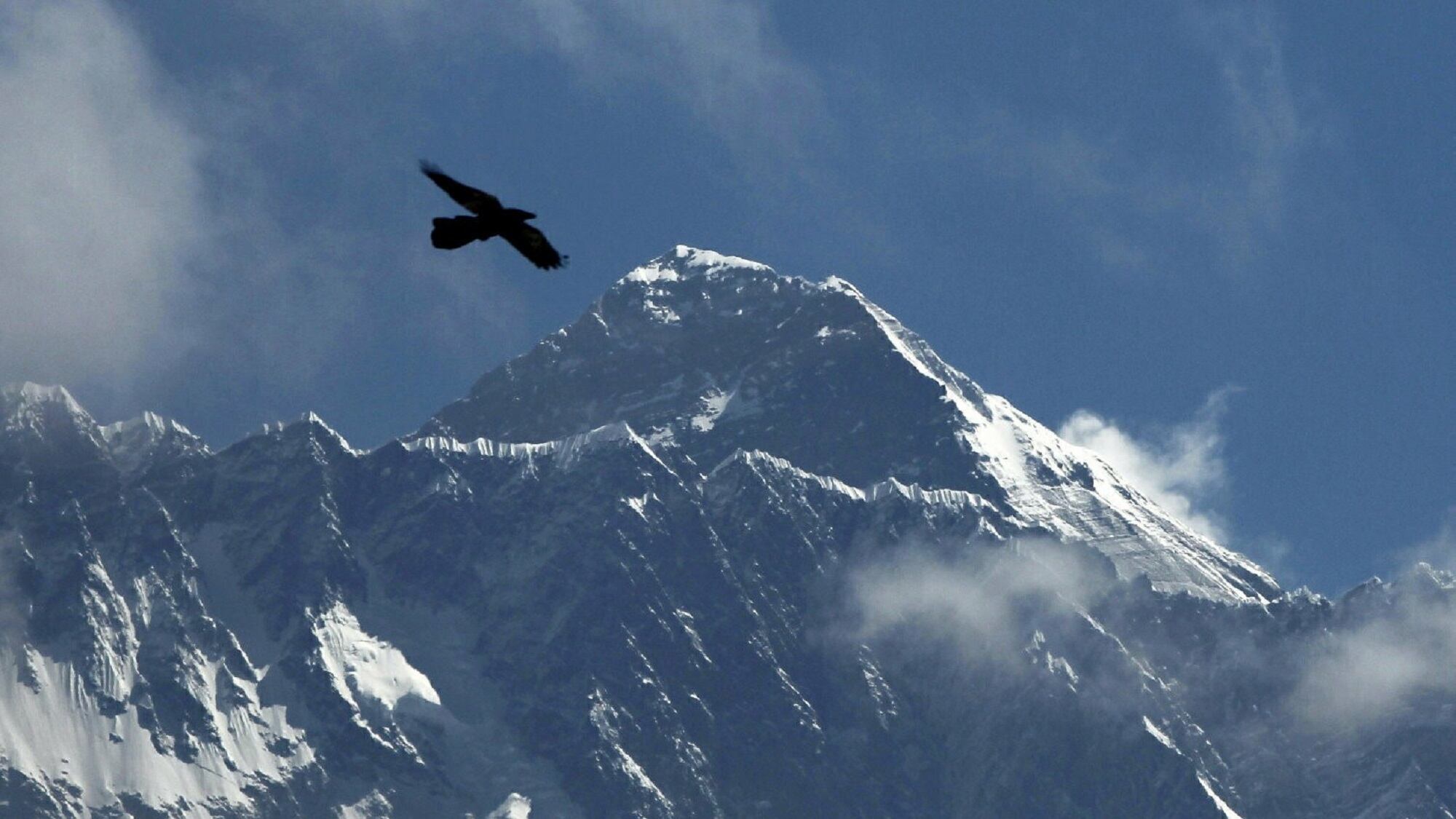
In this May 27, 2019, file photo, a bird flies with Mount Everest seen in the background from Namche Bajar, Solukhumbu district, Nepal. (AP Photo/Niranjan Shrestha, File)
By Binaj Gurubacharya
China and Nepal jointly announced a new official height for Mount Everest on Tuesday, ending a discrepancy between the two nations.
The new height of the world's highest peak is 8,848.86 meters (29,031.7 feet), which is slightly more than Nepal’s previous measurement and about four meters (13 feet) higher than China’s.
Chinese Foreign Minister Wang Yi and his Nepalese counterpart, Pradeep Gyawali, simultaneously pressed buttons during a virtual conference and the new height flashed on the screen.
The height of Everest, which is on the border between China and Nepal, was agreed on after surveyors from Nepal scaled the peak in 2019 and a Chinese team did the same in 2020.
There had been debate over the actual height of the peak and concern that it might have shrunk after a major earthquake in 2015. The quake killed 9,000 people, damaged about 1 million structures in Nepal and triggered an avalanche on Everest that killed 19 people at the base camp.
There was no doubt that Everest would remain the highest peak because the second highest, Mount K2, is only 8,611 meters (28,244 feet) tall.
Everest's height was first determined by a British team around 1856 as 8,842 meters (29,002) feet.
But the most accepted height has been 8,848 meters (29,028 feet), which was determined by the Survey of India in 1954.
In 1999, a National Geographic Society team using GPS technology came up with a height of 8,850 (29,035 feet). A Chinese team in 2005 said it was 8,844.43 meters (29,009 feet) because it did not include the snow cap.
A Nepal government team of climbers and surveyors scaled Everest in May 2019 and installed GPS and satellite equipment to measure the peak and snow depth on the summit.
Chinese President Xi Jinping visited Nepal later that year and the leaders of the two countries decided that they should agree on a height.
A survey team from China then conducted measurements in the spring of 2020 while all other expeditions were canceled due to the coronavirus pandemic.
Nepal's climbing community welcomed the end of confusion over the mountain's height.
“This is a milestone in mountaineering history which will finally end the debate over the height and now the world will have one number,” said Santa Bir Lama, president of the Nepal Mountaineering Association.
China's official Xinhua New Agency quoted Xi as saying the two sides are committed to jointly protecting the environment around Everest and cooperating in scientific research.
For China, the announcement appeared to be as much about politics as geography. China has drawn Nepal ever closer into its orbit with investments in its economy and the building of highways, dams, airports and other infrastructure in the impoverished nation.
That appears to serve China’s interests in reducing the influence of rival India, with which it shares a disputed border, and Nepal’s role as a destination for refugee Tibetans.
The Xinhua report said nothing about the technical aspects but heavily emphasized the joint announcement’s geopolitical weight.
China and Nepal will establish an “even closer community of a shared future to enrich the countries and their peoples,” Xinhua quoted Xi as saying.
A deal was reached as the COP26 Summit in Glasgow came to a close. Dr. Katharine Hayhoe, Chief Scientist at the Nature Conservancy and Author of 'Saving Us: A Climate Scientist's Case for Hope and Healing in a Divided World,' joined Cheddar News' Closing Bell to discuss the deal.
Over the years many people have gotten into the act of living a sustainable life all in the hopes of helping to protect and save the plant. However, some argue that living in this kind of fashion is expensive and only accessible to the wealthy. Editor at Large at CNET Farnoosh Torabi, joined Cheddar to discuss more.
As we move into the colder months in the U.S., health experts are warning of a more active flu season than last year, sounding the alarm on what many are calling a 'twindemic.' Dr. Syra Madad, infectious disease epidemiologist, joined Cheddar's 'Search for the Cure' to discuss the intersection of the flu season with the Covid-19 pandemic.
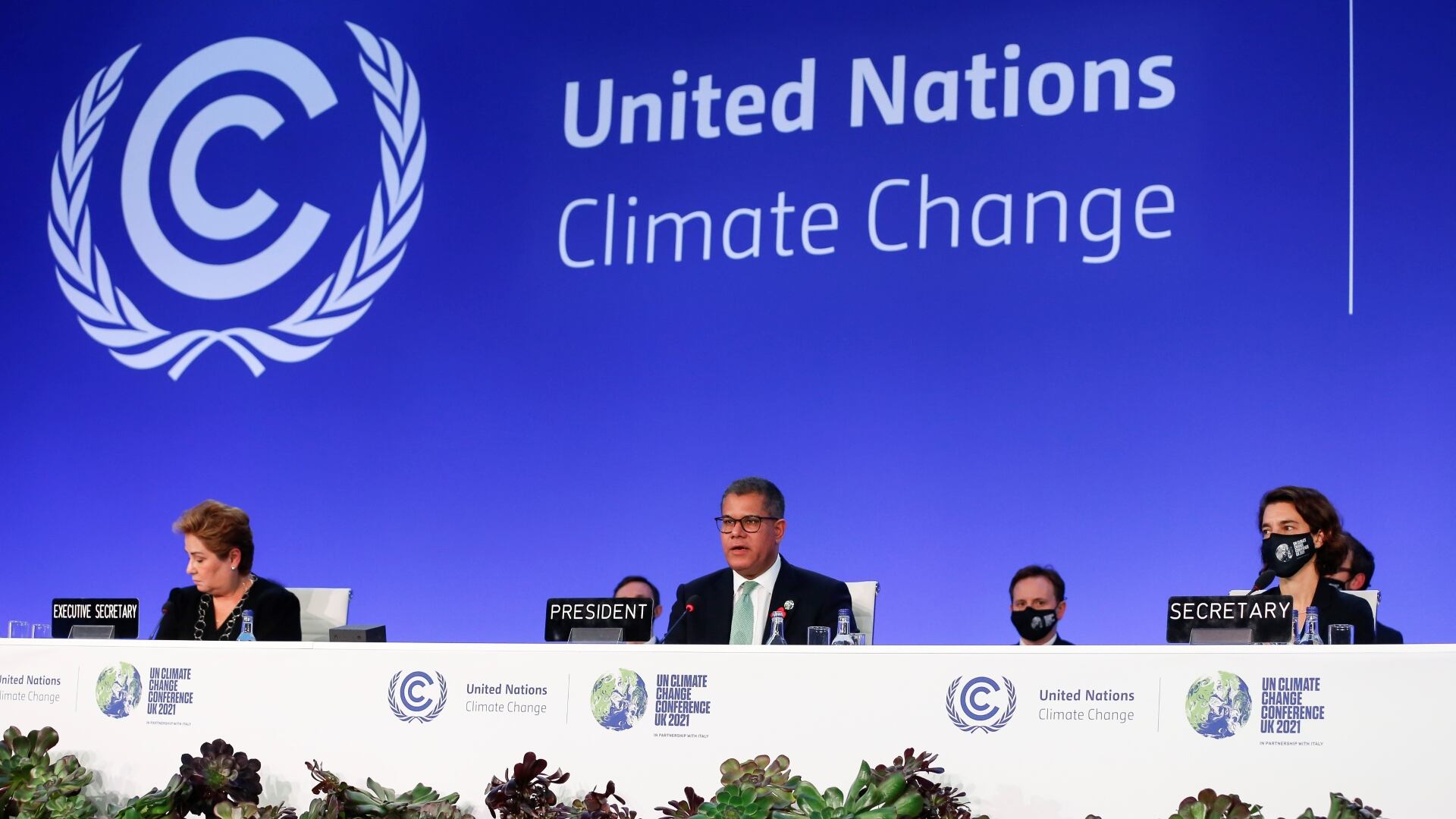
The UN climate summit wrapped up over the weekend after days of negotiations over the summit's final agreement. The agreement pushes countries to reassess their climate goals by the end of next year, do more for countries facing the worst effects of climate change, and also calls for a "phase down" of coal and other fossil fuel subsidies. The White House praised the agreement, but underscored the feelings of many world leaders by saying it isn't enough.
Deborah Brosnan, climate expert and president of Deborah Brosnan and Associates, joined Cheddar's News Wrap to discuss.
Dr. Joseph Sellers, President of the Medical Society of the State of New York and Pediatrician at Basset Medical Group, joined Cheddar News for an update on vaccinations for kids under 12 now that the rollout has officially begun.
President Biden is under some pressure from members of his own party over rising gas prices. Senate Majority Leader Chuck Schumer has called for the president to utilize oil reserves to lower gas prices ahead of the holiday season, as gas prices are currently at a seven-year high. Energy Workforce & Technology Council CEO Leslie Beyer joins Cheddar News' Closing Bell to discuss.
Russia is being blamed for putting the International Space Station and its crew at risk after it fired a missile during a weapons test at a non-functional satellite. NASA has said that the debris from the explosion could potentially orbit the Earth for decades.
Cases of covid-19 are climbing in the Upper Midwest, Southwest, and parts of the Northeast. The seven-day national average is sitting at roughly 82,000 new cases which is an 11 percent jump from the week before. Dr. Amesh Adalja, Infectious Disease, Specialist, Sr. Scholar at Johns Hopkins Center for Health Security joined Cheddar's Opening Bell to discuss this recent uptick ahead of the holiday season.
Jill is joined by Baker Machado to talk all things infrastructure: where will the money go and who’s in charge? Plus, Sesame Street has its first Asian-American muppet. And a trailer for the trailer for Spiderman. Huh?
Booking.com has unveiled a first-of-its-kind sustainable travel designation for properties that might be on the itinerary of a climate-conscious traveler. CEO Glenn Fogel explained to Cheddar the key metrics a location has to achieve to earn a sustainability badge. Waste handling, energy and greenhouse gases, water usage, local community support, and protection of nature were the five top areas of concern he addressed, with an additional subset of 32 measures that properties can implement.