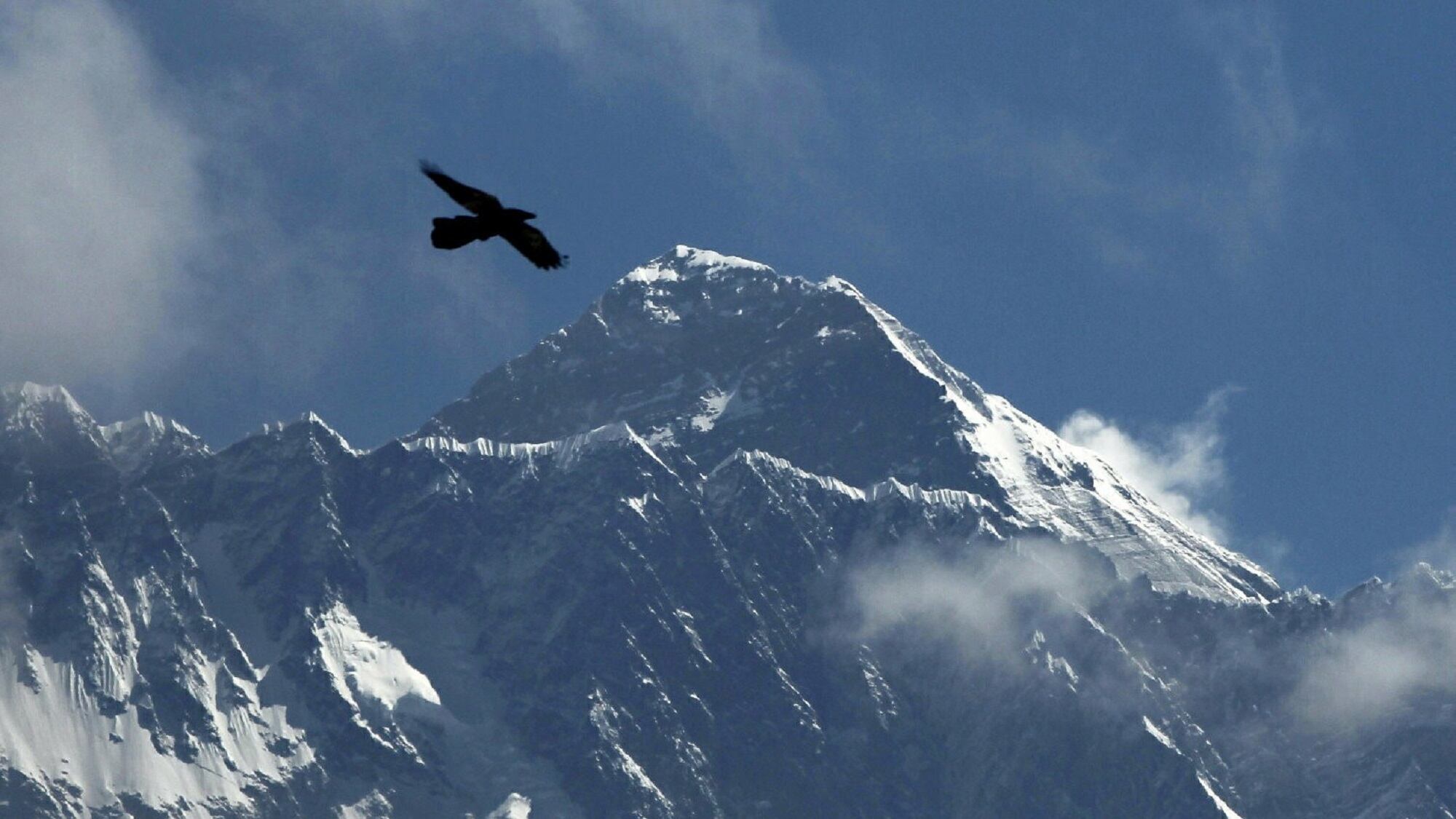
In this May 27, 2019, file photo, a bird flies with Mount Everest seen in the background from Namche Bajar, Solukhumbu district, Nepal. (AP Photo/Niranjan Shrestha, File)
By Binaj Gurubacharya
China and Nepal jointly announced a new official height for Mount Everest on Tuesday, ending a discrepancy between the two nations.
The new height of the world's highest peak is 8,848.86 meters (29,031.7 feet), which is slightly more than Nepal’s previous measurement and about four meters (13 feet) higher than China’s.
Chinese Foreign Minister Wang Yi and his Nepalese counterpart, Pradeep Gyawali, simultaneously pressed buttons during a virtual conference and the new height flashed on the screen.
The height of Everest, which is on the border between China and Nepal, was agreed on after surveyors from Nepal scaled the peak in 2019 and a Chinese team did the same in 2020.
There had been debate over the actual height of the peak and concern that it might have shrunk after a major earthquake in 2015. The quake killed 9,000 people, damaged about 1 million structures in Nepal and triggered an avalanche on Everest that killed 19 people at the base camp.
There was no doubt that Everest would remain the highest peak because the second highest, Mount K2, is only 8,611 meters (28,244 feet) tall.
Everest's height was first determined by a British team around 1856 as 8,842 meters (29,002) feet.
But the most accepted height has been 8,848 meters (29,028 feet), which was determined by the Survey of India in 1954.
In 1999, a National Geographic Society team using GPS technology came up with a height of 8,850 (29,035 feet). A Chinese team in 2005 said it was 8,844.43 meters (29,009 feet) because it did not include the snow cap.
A Nepal government team of climbers and surveyors scaled Everest in May 2019 and installed GPS and satellite equipment to measure the peak and snow depth on the summit.
Chinese President Xi Jinping visited Nepal later that year and the leaders of the two countries decided that they should agree on a height.
A survey team from China then conducted measurements in the spring of 2020 while all other expeditions were canceled due to the coronavirus pandemic.
Nepal's climbing community welcomed the end of confusion over the mountain's height.
“This is a milestone in mountaineering history which will finally end the debate over the height and now the world will have one number,” said Santa Bir Lama, president of the Nepal Mountaineering Association.
China's official Xinhua New Agency quoted Xi as saying the two sides are committed to jointly protecting the environment around Everest and cooperating in scientific research.
For China, the announcement appeared to be as much about politics as geography. China has drawn Nepal ever closer into its orbit with investments in its economy and the building of highways, dams, airports and other infrastructure in the impoverished nation.
That appears to serve China’s interests in reducing the influence of rival India, with which it shares a disputed border, and Nepal’s role as a destination for refugee Tibetans.
The Xinhua report said nothing about the technical aspects but heavily emphasized the joint announcement’s geopolitical weight.
China and Nepal will establish an “even closer community of a shared future to enrich the countries and their peoples,” Xinhua quoted Xi as saying.
On this episode of Cheddar Innovates: President of The Pillow Bar breaks down how everyone can benefit from a pillow customized to their unique way of sleeping; CEO of H2Pro explains how to bring environmentally friendly hydrogen to scale; Cheddar gets a look at Curiosity Stream's 'Suppressed Science.'
On this episode of Cheddar Innovates: Gardenuity CEO breaks down how gardening can improve your wellbeing; Augmedix CEO discusses how this technology is helping doctors fight burnout; Cheddar gets a look at Curiosity Stream's 'Suppressed Science.'
On this episode of Cheddar Innovates: Atom Limbs CEO breaks down how the Atom Touch prosthetic is different from other prosthetics on the market; CEO & Chief Scientific Officer of MyMD explains how the MYMD-1 is on track to be the first FDA-approved drug to treat aging and age-related diseases; A look at Curiosity Stream's 'The Future of Warfare.'
On this episode of Cheddar Innovates: SkilsVR CEO explains how virtual reality is being used to train frontline workers to handle difficult customers; Rubicon CEO breaks down how technology and sustainability will go hand in hand in the future; Cheddar gets a look at 'Our Infinite Universe.'
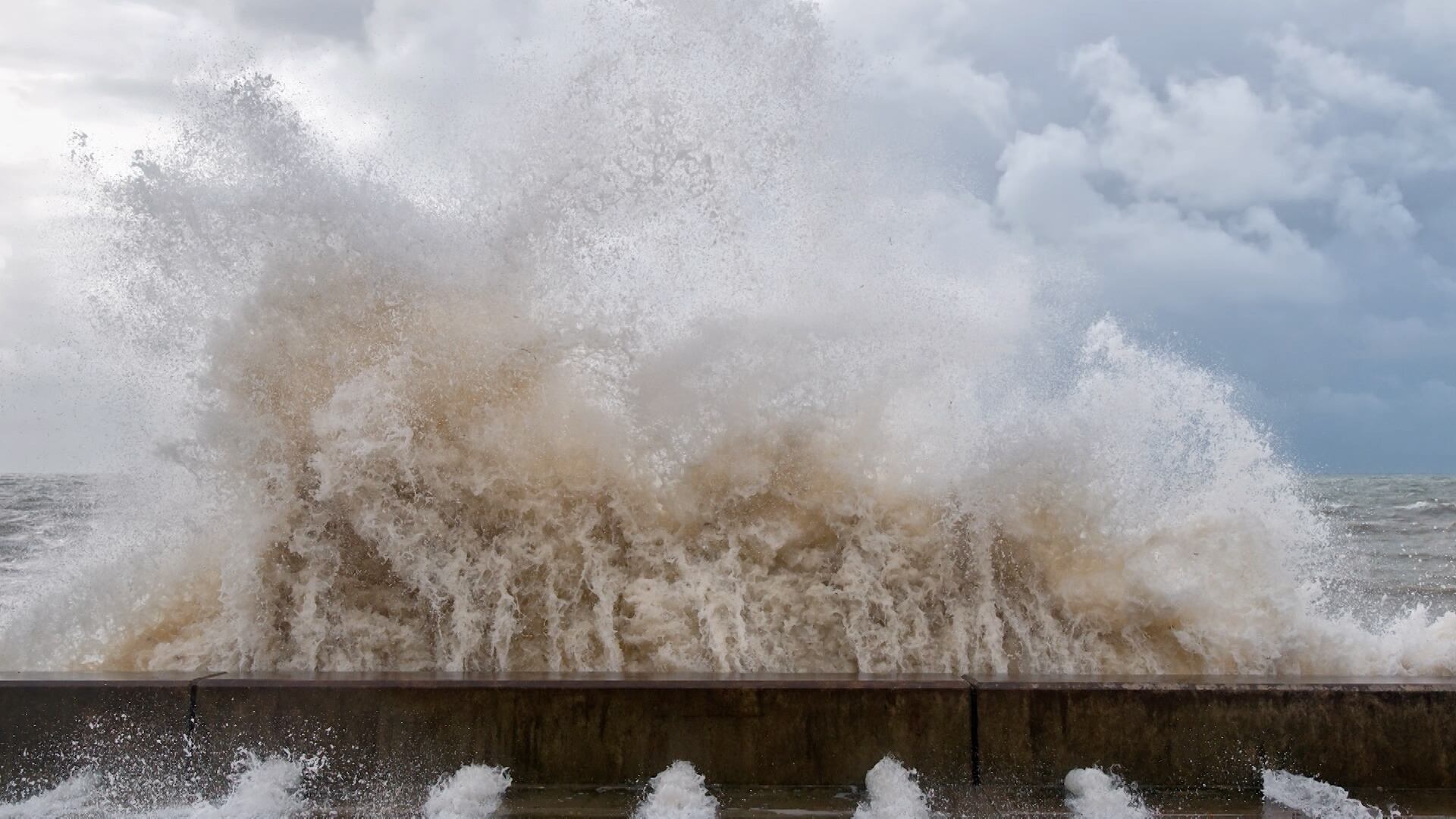
A UN report is warning that relying on seawalls and other engineering fixes will not be enough to keep communities safe from rising sea levels and climate change consequences. Dr. Steve Rose, a senior research economist at the Electric Power Research Institute, joins Cheddar News to discuss.
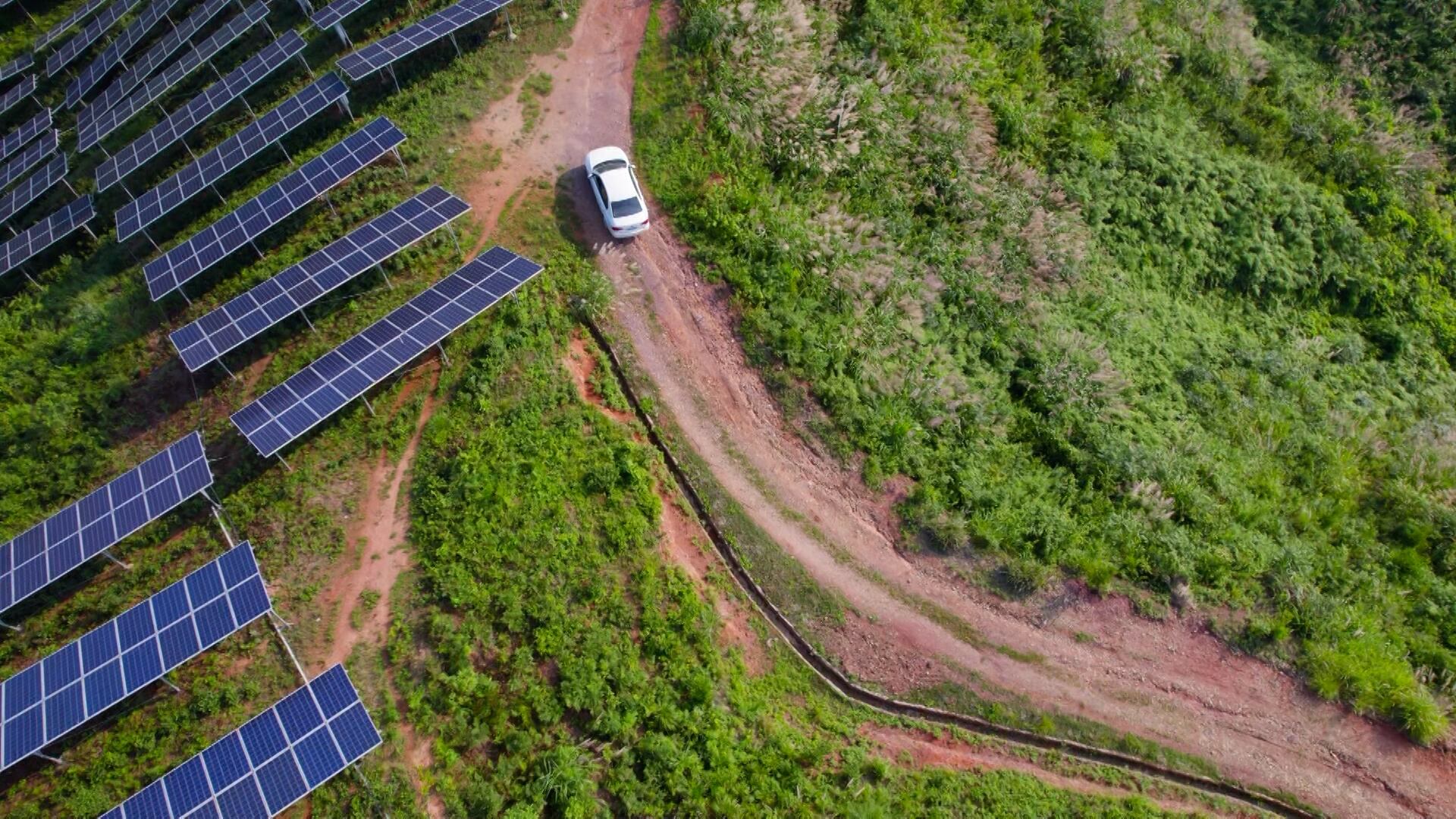
As gas prices surge amid the Russian invasion of Ukraine, other nations could potentially transition faster to using clean energy than previously expected. Philip K. Verleger, a senior fellow at the Niskanen Center, joined Cheddar News to explain how this could be a possibility in the near future. "Part of the reason I think we have this invasion and the tantrum that's being thrown by Russia, terrible tantrum, is because the Russians were trying to slow down the transition," he said. "Ironically they speeded it up."
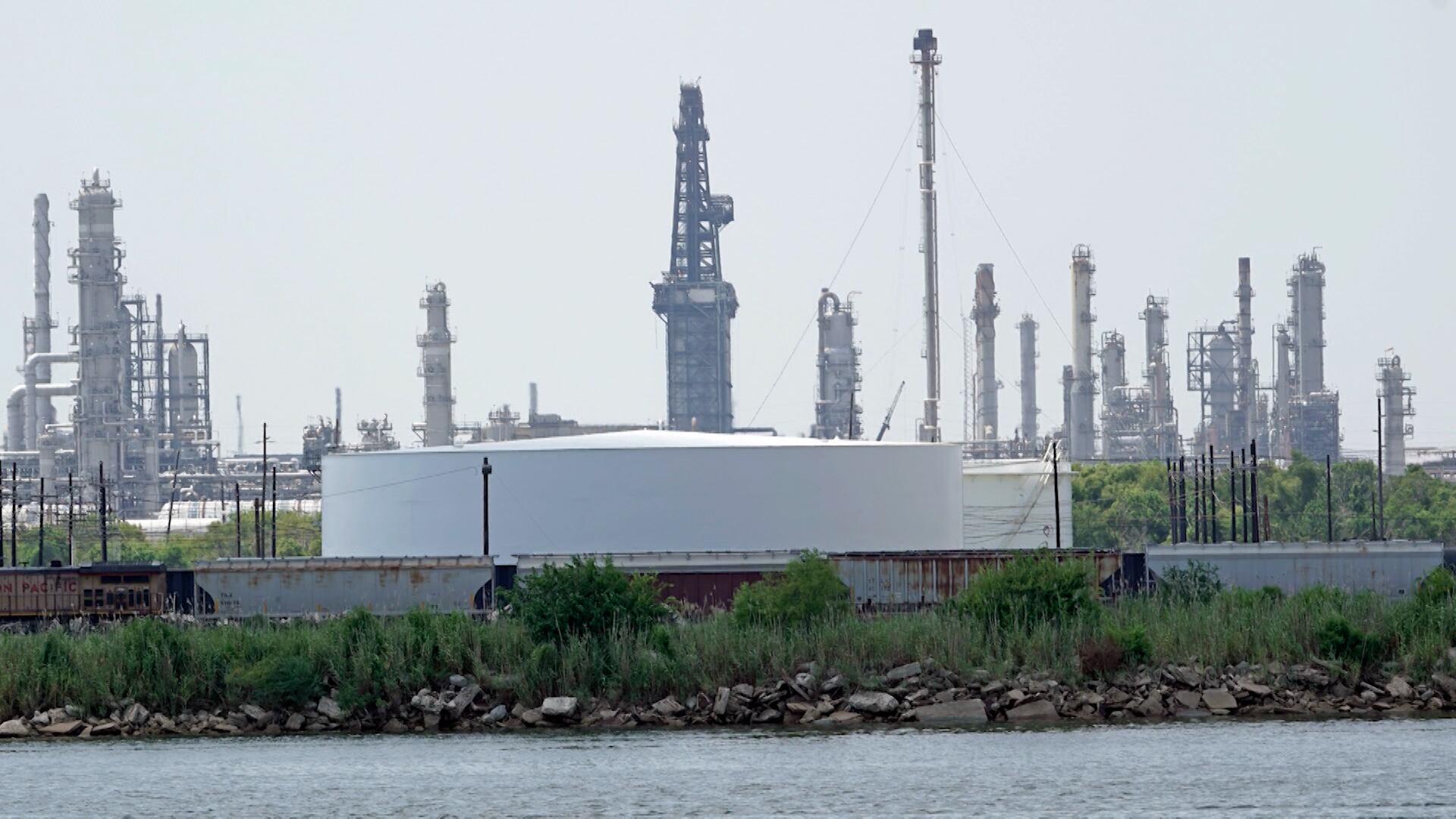
As Russia intensifies its war on Ukraine, President Biden announced a ban on oil imported from the aggressor nation. Critics of Russia have said this would be the best way to force Putin to pull back, but curbs on Russian oil exports are expected to send already skyrocketing oil and gas prices even higher, further impacting consumers, businesses, financial markets, and the global economy. Leslie Beyer, CEO of the Energy Workforce and Technology Council, joined Cheddar News' Closing Bell to discuss. "It's certainly going to increase pricing, but it is the right thing to do," she said. "The industry itself has already pulled out of the significant portion of its operations in Russia."
On this episode of Cheddar Innovates: Vision Marine Technologies CEO discusses how e-boats will play a role in the fight against the climate crisis; Lasso CEO breaks down how the design behind these compression socks can prevent injuries and improve performance; Cheddar gets a look at Curiosity Stream's 'The Tombs Of Egypt.'
Vaccine maker Pfizer delayed its COVID shot for kids allegedly due to a lack of data on how it would perform against the omnicron variant, according to the Wall Street Journa. Peter Pitts, professor and founder of the Center for Medicine in the Public Interest and a former FDA associate commissioner, joined Cheddar News Wrap to break down why the authorization can't be rushed. "Going forward, the FDA wants to look at data specifically against omicron, and it looks like that's going to be a three-shot regimen versus two, which was efficient against delta but not omicron because obviously omicron is more infectious," said Pitts.
Walker Ross, Assistant Professor of Sports Business Management at Florida Southern College, joins Business of Sports: The Beijing Winter Olympics 2022, where he says that actions Beijing and other Olympic host sites have been implementing to combat climate change has simply not been enough to offset their carbon footprint.