By Howard Fendrich
A poor start left Carlos Alcaraz a single point from a two-set hole against Novak Djokovic in the Wimbledon final.
That sort of deficit is daunting for anyone, let alone a 20-year-old in his second major final, and against anyone, let alone Djokovic, someone who hadn't lost at Centre Court in a decade, someone seeking a fifth consecutive championship, and record-tying eighth overall, at the All England Club. Someone who won the year's first two Grand Slam tournaments and 23 over his career.
Ah, but Alcaraz, last year's U.S. Open champ, wanted this shot at Djokovic, someone he called "a legend of our sport." Said it would make winning Wimbledon that much more special. And so Alcaraz managed to come through in that tiebreaker as choruses of “Car-los! Car-los!” from the stands competed with cries of his older, more experienced, more accomplished foe's two-syllable nickname, "No-le! No-le!” And then Alcaraz came through in a 32-point, 25-minute masterpiece of a game soon thereafter. And, crucially, the Spaniard came through in the crucible of a fifth set, too.
Add it all up, and the No. 1-ranked Alcaraz marked himself as the star people have been predicting he would be, transforming potential into triumph and putting an end to Djokovic’s 34-match winning streak at the All England Club all in one fell swoop by edging him 1-6, 7-6 (6), 6-1, 3-6, 6-4 in an engaging, back-and-forth final on Sunday. Alcaraz claimed his first title at Wimbledon and second Grand Slam trophy overall.
“Didn’t get down, didn’t give up,” said Alcaraz, the third-youngest man to win the grass-court major in the Open era, which began in 1968, after Boris Becker and Bjorn Borg. “We made great rallies, great points. It was a long, long match. Long sets. It was the mental part that allowed me to stay there.”
He is the first man outside the elite quartet of Djokovic, Roger Federer, Rafael Nadal and Andy Murray to win Wimbledon since 2002 and, to many, this symbolized a transfer of power in men's tennis.
“I haven’t played a player like him. Ever,” said Djokovic, quite a statement from a guy who competed against Federer and Nadal for so long and in so many remarkable matches.
“He's proven,” Djokovic said, “that he’s the best player in the world, no doubt.”
The age gap between Alcaraz and the 36-year-old Djokovic, who wiped away tears during the trophy ceremony, was the widest in any men’s Slam final since 1974.
So Alcaraz had youth on his side, which he also did, of course, when they met in the French Open semifinals last month. That one was extraordinary for two sets before Alcaraz cramped up and faded. This time, he had the stamina and the strokes to get past Djokovic — and the belief that he could win.
After Alcaraz made nine unforced errors in the opening set to Djokovic's two, showing signs of the nerves that hit him in Paris, things began to shift Sunday. At 4-all in the second set, Djokovic slipped on a worn patch behind the baseline under the Royal Box, flinging his racket away as he fell. At the next changeover, Djokovic flexed one leg by bending it over the other, then plopped his left heel on the net for additional stretching.
They would head to a tiebreaker, Djokovic’s dominion: He had won all six such set-enders he played at Wimbledon leading up to the final, and 15 straight in Grand Slam action.
Unflustered by a warning from chair umpire Fergus Murphy for taking too much time to serve, Djokovic pulled ahead 6-5. A set point.
But two netted backhands by Djokovic put Alcaraz within a point of that set.
“The backhands kind of let me down,” Djokovic would say later.
Alcaraz then struck a backhand passing winner off the return of a 118 mph serve, holding the pose of his follow-through. As people in the stands rose to roar, Alcaraz spun around with his right hand to his ear, soaking in the moment.
“If I would have lost that set, probably I couldn’t lift the trophy,” Alcaraz said. “I probably could have lost in three sets.”
They were two hours and two sets in.
One set each.
Now it was a match.
It began to feel memorable.
The fifth game of the third set might have been worth the high price of admission, in and of itself. Neither man wanted to bend. Neither wanted to cede a thing. It was one game, yes, but seemed meaningful.
When Djokovic slapped a forehand into the net to get broken — one of five times he dropped serve in the match, more than his previous six opponents managed combined — Alcaraz celebrated his 4-1 edge in the set by throwing his head back and screaming “Vamos!”
But Djokovic did not go away. He raised his level again, pushing this terrific tussle to a fifth set.
One of several reasons to like Djokovic’s chances at that juncture: He went into Sunday with a 10-1 record in five-setters at Wimbledon and 35-9 at all majors.
Those matches, however, were in the past.
Alcaraz is the future.
His serves top 130 mph. His sledgehammer of a forehand tops 100 mph, unleashed in such a manner as to make an observer believe every ounce of strength, every fiber of his being, is invested in each swing. The smack of the racket, and his “Uhhh-ehhh!” exhale of exertion — along with the gasps of impressed onlookers — reverberated around the arena.
He displays as varied a game as possible, from his volleying ability to the well-disguised drop shots that helped him get back into the thick of it in the second and third sets.
Djokovic, meanwhile, is equipped with an abundance of talents, too, and so much muscle memory. So often, he would hustle and stretch and slide nearly into the splits to get Alcaraz’s apparent point-ending shots back in ways no one else could.
Plus, he's been there, and done that, in ways Alcaraz, for now, can only dream of.
But if this victory on a windy and cloudy day is any indication, Alcaraz is on his way to achieving quite a bit himself.
He moved out front for good by breaking to go up 2-1 in the fifth with a backhand passing winner. Djokovic, who fell during the point but quickly popped back up, reacted by slamming his racket into the net post, letting go on impact. He destroyed his equipment and earned a code violation from Murphy.
“Frustration in the moment,” Djokovic called it.
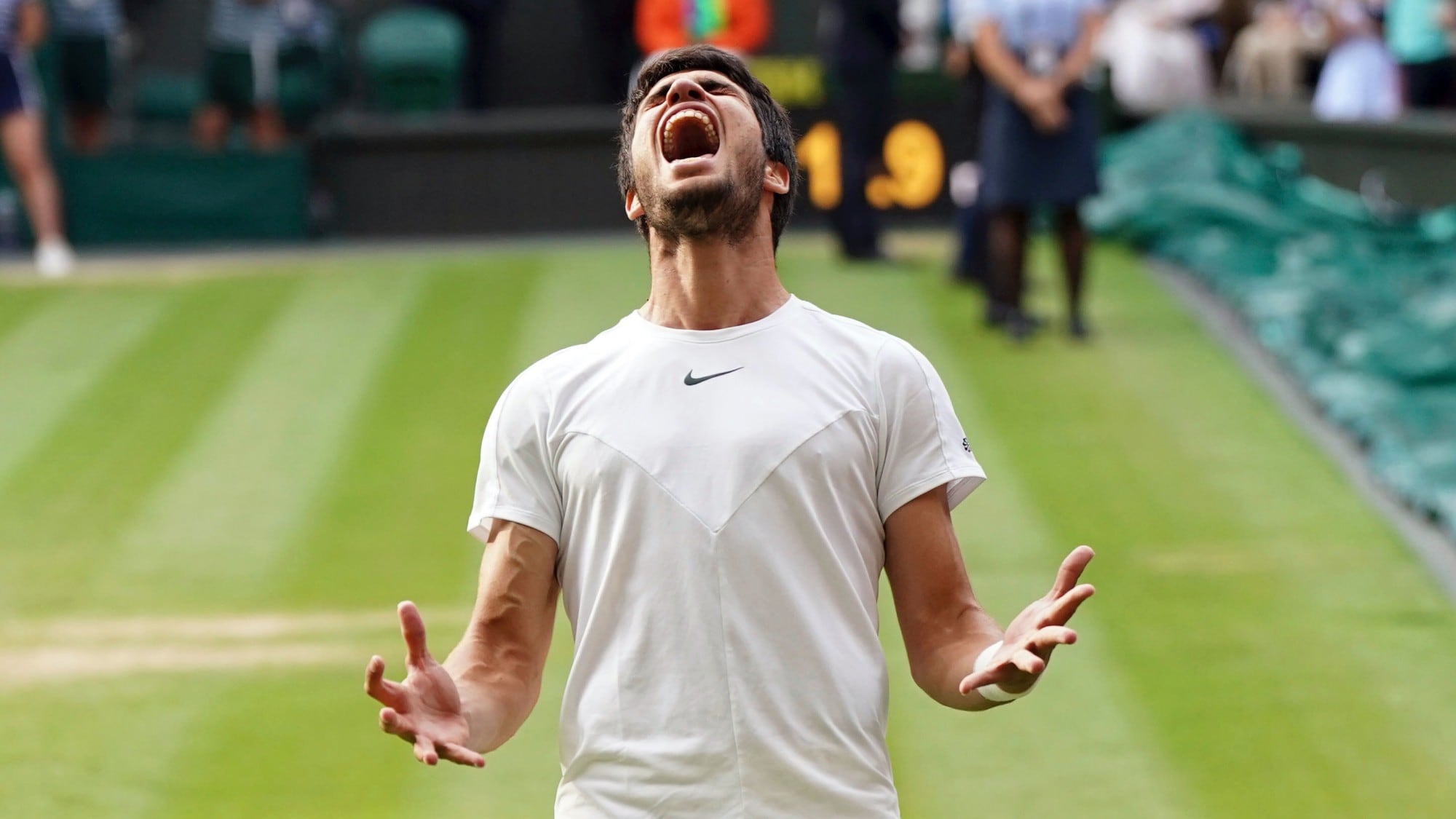
They would play on for another 24 minutes, but Alcaraz never relented, never gave way, no matter the skill and will possessed by the man across the net. And it was Alcaraz, not Djokovic, who covered his face and rolled in the grass after the final point, then received the gold trophy.
“It’s something that I will never forget,” Alcaraz said. “That’s for sure.”