Airlines are looking to turn the blue skies green.
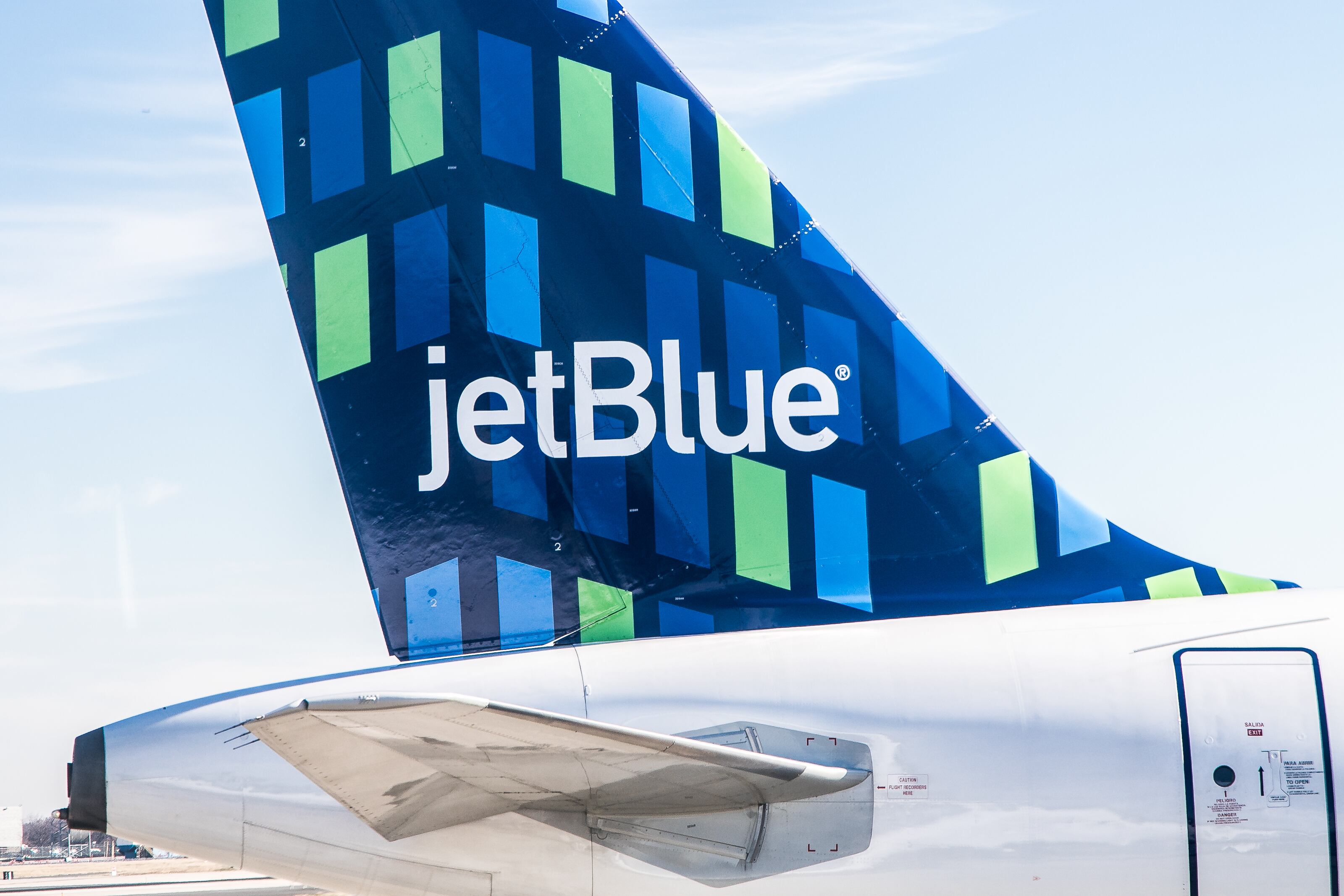
JetBlue this week became the first U.S. airline to announce plans to go carbon-neutral on all of its domestic flights by buying so-called "carbon offsets."
While the flightpath to a truly zero-emissions plane remains years away – the first all-electric commercial aircraft, a battery-powered four-seater, just took its first test flight near Vancouver last month – JetBlue plans to invest in green projects designed to absorb or avoid the greenhouse gas emissions being produced by the airline's 1,000 daily flights.
The idea is that for every ton of carbon produced by the airline's jets, JetBlue will invest in forestry programs, gas-capture mechanisms, and renewable energy projects that will essentially "offset" the planes' greenhouse gases. Domestic and international flights generated about 2.4 percent of the world's energy-related carbon dioxide emissions in 2018, soaring 26 percent from just five years earlier.
"We can't eliminate the emissions and pollution coming out of the tailpipes of our airplanes, but we can find solutions on the ground, like supporting solar and wind farms and capturing methane pollution from a landfill," Sophia Mendelsohn, JetBlue's head of sustainability, said in an interview with Cheddar. "When we do that, we essentially get a credit that offsets your flight."
The announcement came two months after the European budget carrier EasyJet became the world's first airline to declare that it would offset all of its emissions. Airlines are facing heightened scrutiny on the climate impacts of air travel and the rise of so-called "flight shame," much of it precipitated by, or at least attributed to, Swedish teenage climate activist – and Time person of the year – Greta Thunberg.
"The airline industry knows that they have a carbon problem, they've known it for a long time, and they have started working on a solution to it," said Annie Petsonk, international counsel for the Environmental Defense Fund and an expert on sustainability efforts in the aviation sector. "In the face of Greta Thunberg, the airlines are really scrambling."
With few technologies yet available to replace flights – especially for long-haul travel – offsets offer a relatively easy and, notably, inexpensive way for airlines to show that they're addressing fliers' concerns. That has spurred some experts to question whether such schemes go far enough.
"For flyers, who have very limited control over emissions from their flight, I consider personal offsetting reasonable. For airlines, which control every lever available to limit emissions – they buy the planes, fuel them, route them, pilot them, fill them – I consider offsets to be basically kicking the can down the road," Dan Rutherford, program director for marine and aviation at the International Council on Clean Transportation, wrote in an email to Cheddar. "The focus should be on reducing emissions through improved operations, more fuel-efficient aircraft and engines, and clean fuels starting today."
The airplane maker Airbus, for example, announced last fall that it plans to examine "vortex surfing," where long-haul aircraft draft off one another to cut fuel consumption and carbon emissions by as much as 10 percent. But testing the program, getting sign-offs from regulators, and implementing it, will likely take years; the U.S. Air Force nixed a similar idea after testing it in 2013 due to logistical challenges.
"There are not near-term, off-the-shelf technology solutions to reducing emissions from aviation," Petsonk said. "For people who fly, what do they have in the interim? If they can have high-quality offsets that are not double-counted, that's better than not."
Double-counting is one of the main concerns with carbon offset schemes. The programs aren't new, but they can be opaque – and, without the right accounting mechanisms or safeguards, can actually make emissions worse by allowing polluters to mask just how much heat-trapping gas their factories and vehicles are generating.
The United Nations' Clean Development Mechanism, for example, which became the central carbon-offset regime in Europe, failed to reduce the vast majority of emissions, largely because the same credits could be counted for multiple emissions sources.
"Some of those projects were good, some of those projects were very bad, but it's very much true that under that approach, one bad apple spoiled the bunch, because on the surface the programs look the same," said Peter Miller, director of the Western Region of the Climate and Clean Energy Program at the Natural Resources Defense Council.
There is little to no domestic regulation of carbon offsets, although international organizations and verification regimes have emerged to certify various offset programs. JetBlue, in its description of its carbon offset investment, meanwhile said that it would avoid double-counting by ensuring that each carbon credit it buys has "a unique serial number." Environmental advocates and experts say that they're encouraged – with qualifications.
"JetBlue's announcement is very significant, but there is this proof-in-the pudding question," Petsonk said.
The move should cheer business travelers in particular – or, viewed another way, may have been designed with business travelers in mind. While most fliers seem to be guided by ticket price alone, companies whose employees frequently travel often negotiate lower fares with airlines in exchange for loyalty or exclusivity agreements. As those companies have faced new pressure from younger employees to address climate change, they've in turn put the screws to airlines.
"Companies are getting increasingly asked by their employees, 'What is our company doing about climate change?' So they go to their airlines and say, 'What are you doing about emissions?'" Petsonk said. "We think there is tremendous potential in this sector, and airlines can drive that innovation by demanding lower-emitting flights and, in the interim, until they can get there, by offsetting."