By Collin Binkley
A civil rights group is challenging legacy admissions at Harvard University, saying the practice discriminates against students of color by giving an unfair boost to the mostly white children of alumni.
The practice of giving priority to the children of alumni has faced growing pushback in the wake of last week’s Supreme Court’s decision ending affirmative action in higher education. The NAACP added its weight behind the effort on Monday, asking more than 1,500 colleges and universities to even the playing field in admissions, including by ending legacy admissions.
The civil rights complaint was filed Monday by Lawyers for Civil Rights, a nonprofit based in Boston, on behalf of Black and Latino community groups in New England, alleging that Harvard’s admissions system violates the Civil Rights Act.
“Why are we rewarding children for privileges and advantages accrued by prior generations?” said Ivan Espinoza-Madrigal, the group's executive director. “Your family’s last name and the size of your bank account are not a measure of merit, and should have no bearing on the college admissions process.”
Opponents say the practice is no longer defensible without affirmative action providing a counterbalance. The court’s ruling says colleges must ignore the race of applicants, activists point out, but schools can still give a boost to the children of alumni and donors.
The complaint, submitted with the Education Department’s Office for Civil Rights, draws on Harvard data that came to light amid the affirmative action case that landed before the Supreme Court. The records revealed that 70% of Harvard’s donor-related and legacy applicants are white, and being a legacy student makes an applicant roughly six times more likely to be admitted.
It draws attention to other colleges that have abandoned the practice amid questions about its fairness, including Amherst College and Johns Hopkins University.
The complaint alleges that Harvard’s legacy preference has nothing to do with merit and takes away slots from qualified students of color. It asks the U.S. Education Department to declare the practice illegal and force Harvard to abandon it as long as the university receives federal funding.
“A spot given to a legacy or donor-related applicant is a spot that becomes unavailable to an applicant who meets the admissions criteria based purely on his or her own merit,” according to the complaint. If legacy and donor preferences were removed, it adds, “more students of color would be admitted to Harvard.”
Harvard said it would not comment on the complaint.
“Last week, the University reaffirmed its commitment to the fundamental principle that deep and transformative teaching, learning, and research depend upon a community comprising people of many backgrounds, perspectives, and lived experiences,” the university said in a prepared statement. “As we said, in the weeks and months ahead, the University will determine how to preserve our essential values, consistent with the Court’s new precedent.”
The complaint was filed on behalf of Chica Project, African Community Economic Development of New England, and the Greater Boston Latino Network.
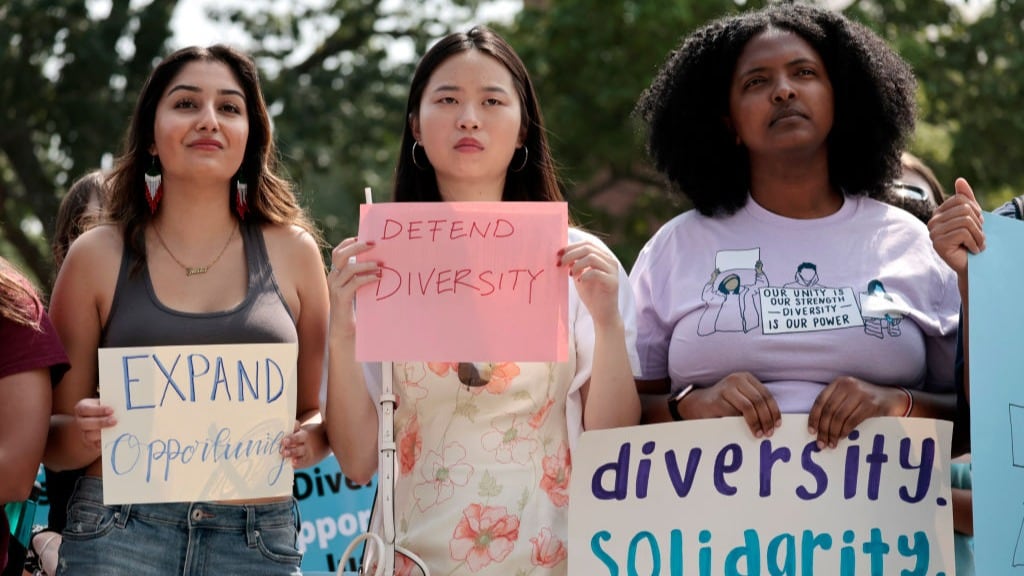
Also Monday, the NAACP launched a campaign aiming to get universities across the nation to promote campus diversity. The group called on 532 public and 1,134 private colleges and universities to end legacy preferences, eliminate “racially biased” entrance examinations, recruit diverse faculty, and support low-income and first-generation students with scholarships and mentoring, among other steps.
“It is our hope that our nation's institutions will stand with us in embracing diversity, no matter what,” said Derrick Johnson president and CEO of the NAACP. “Regardless, the NAACP will continue to advocate, litigate and mobilize to ensure that every Black American has access to the resources and opportunities they need to thrive.”
That effort joins another campaign urging the alumni of 30 prestigious colleges to withhold donations until their schools end legacy admissions. That initiative, led by Ed Mobilizer, also targets Harvard and other Ivy League schools.
President Joe Biden suggested last week that universities should rethink the practice, saying legacy admissions “expand privilege instead of opportunity.”
Several Democrats in Congress demanded an end to the policy in light of the court’s decision, along with Republicans including Sen. Tim Scott of South Carolina, who is vying for the GOP presidential nomination.
It’s unclear exactly which schools provide a legacy boost and how much it helps. In California, where state law requires schools to disclose the practice, the University of Southern California reported that 14% of last year’s admitted students had family ties to alumni or donors. Stanford reported a similar rate.
An Associated Press survey of the nation’s most selective colleges last year found that legacy students in the freshman class ranged from 4% to 23%. At four schools — Notre Dame, USC, Cornell and Dartmouth — legacy students outnumbered Black students.
Supporters of the policy say it builds an alumni community and encourages donations. A 2022 study of an undisclosed college in the Northeast found that legacy students were more likely to make donations, but at a cost to diversity — the vast majority were white.